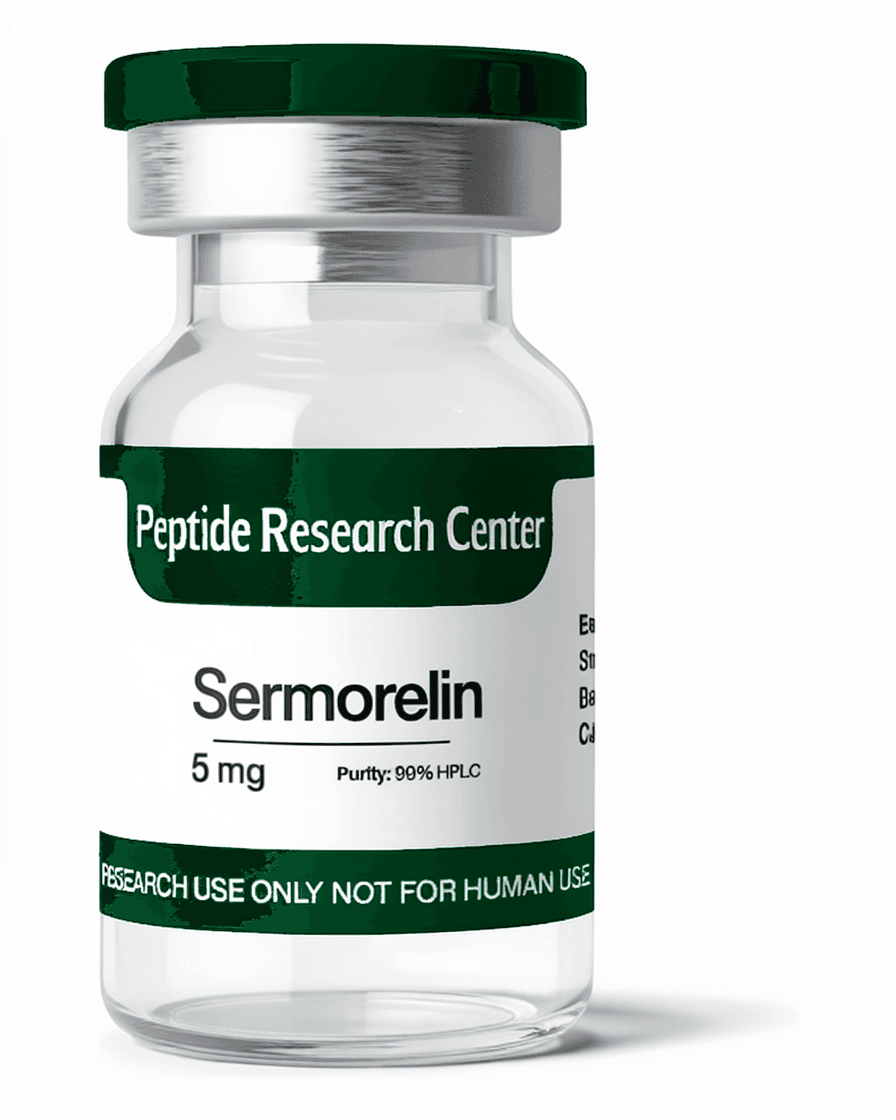
Sermorelin
GHRH (1-29) analog • Growth-hormone research (coming soon)
Sermorelin is a synthetic GHRH (1-29) analog used as a reference growth-hormone-secretagogue peptide in endocrine and metabolic research.
SKU: PRC-SERM-5
Research Use Only. Not for human or veterinary use. By ordering you confirm you are a qualified researcher.
Purity Verification
HPLC Purity
>99% HPLC
Mass Spec Verified
ESI-MS
Certificate of Analysis
Per batch
Preparation & Handling
Supplied as lyophilized powder. Store unreconstituted vials at -20 °C, protected from light. Reconstitute with bacteriostatic or sterile water; once reconstituted, store at 2–8 °C and use within the validated stability window. Do not freeze-thaw repeatedly. For laboratory research use only.
The Science Behind Sermorelin
Sermorelin is the shortest fully active fragment of human growth-hormone-releasing hormone — GHRH(1-29) — and a long-standing reference compound in endocrine research on the GH/IGF-1 axis. The literature spans its structure-activity mapping, its role in generating the natural pulsatile pattern of GH release, and the broader biology of GHRH and its receptor. The summaries below describe that literature with citations, for research context only; this material is for in-vitro and laboratory use, not for human or veterinary use.
Overview
Sermorelin is a synthetic peptide corresponding to the biologically active 1-29 fragment of human growth-hormone-releasing hormone, GHRH(1-29)-NH₂ — the shortest fragment that retains the full GH-releasing activity of the native 44-residue hormone. It serves as a reference GHRH-receptor agonist across endocrine research. [1]
Molecular identity & half-life
Structure-activity studies systematically mapped which residues of GHRH(1-29)-NH₂ are essential for receptor binding and activation. [1] Unlike the engineered long-acting analogues CJC-1295 and tesamorelin, unmodified sermorelin is rapidly degraded (in part by DPP-4) and therefore has a short circulating half-life — a property that makes it a useful tool for studying the native, short-pulse GHRH signal rather than sustained stimulation.
Mechanism: GH pulse generation
As a GHRH-receptor agonist on pituitary somatotrophs, sermorelin drives synthesis and release of growth hormone. In human “clamp” studies, continuous GHRH(1-29)NH₂ amplified GH pulse amplitude while preserving pulse timing, supporting a role for GHRH in GH synthesis and the replenishment of stored GH pools, with somatostatin tone shaping the timing of pulses. [2]
GHRH-receptor biology beyond the pituitary
GHRH and its receptor have been studied well beyond the pituitary. In-vitro work reported GHRH(1-29)NH₂ effects on proliferation and VEGF secretion in a human neuroendocrine tumour cell line, [3] and a wider body of research on GHRH-receptor agonists and antagonists has examined their signalling in diverse peripheral tissues, illustrating that GHRH biology extends past simple GH release. [4]
Research-use context
Sermorelin's history as an endocrine research tool — and, historically, a diagnostic agent for GH-axis testing — does not extend to the research-grade material offered here. This product is supplied strictly for in-vitro and laboratory study by qualified professionals; it is not formulated, dosed, or authorised for use in humans or animals, and nothing here constitutes a therapeutic claim.
References
- 1.Cervini LA, Donaldson CJ, Koerber SC, Vale WW, Rivier JE. Human growth hormone-releasing hormone hGHRH(1-29)-NH2: systematic structure-activity relationship studies. J Med Chem. 1998;41(5):717–727.
- 2.Achermann JC, Hindmarsh PC, Robinson IC, Matthews DR, Brook CG. The relative roles of continuous GHRH(1-29)NH2 and intermittent somatostatin in growth hormone pulse generation. Clin Endocrinol (Oxf). 1999;51(5):575–585.
- 3.Stepień T, Sacewicz M, Lawnicka H, et al. Stimulatory effect of GHRH(1-29)NH2 on proliferation, VEGF and chromogranin A secretion by human neuroendocrine tumor cell line NCI-H727 in vitro. Neuropeptides. 2009;43(5):397–400.
- 4.Schally AV, Wang H, He J, et al. Agonists of growth hormone-releasing hormone (GHRH) inhibit human experimental cancers in vivo by down-regulating receptors for GHRH. Proc Natl Acad Sci U S A. 2018;115(47):12028–12033.
Research Use Only. The information above is provided for educational and reference purposes only and summarizes third-party laboratory and preclinical research. Peptide Research Center products are intended solely for in-vitro and laboratory research by qualified professionals — not for human or veterinary use, diagnosis, or treatment. Nothing here constitutes medical advice or a therapeutic claim.
Related Research Compounds
 >99% HPLC
CJC-1295 / Ipamorelin
CJC-1295 (No-DAC) + Ipamorelin • Growth-hormone research blend
 >99% HPLC
Ipamorelin
Selective GH secretagogue • GH axis research
 >99% HPLC
Tesamorelin
GHRH analog • Growth hormone axis research