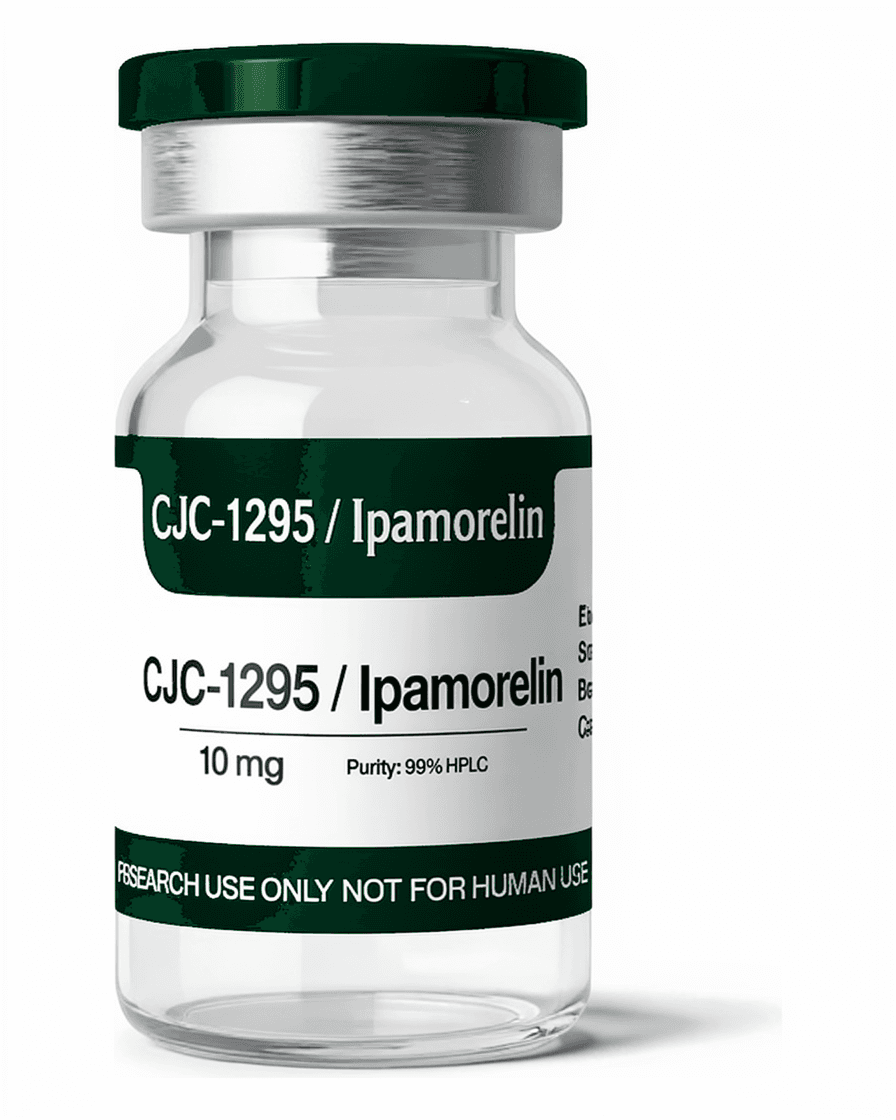
CJC-1295 / Ipamorelin
CJC-1295 (No-DAC) + Ipamorelin • Growth-hormone research blend
A research blend of CJC-1295 (No-DAC / Mod GRF 1-29) and Ipamorelin — two complementary growth-hormone-secretagogue peptides supplied co-lyophilized for reproducible study.
SKU: PRC-CJCIPA-10
Research Use Only. Not for human or veterinary use. By ordering you confirm you are a qualified researcher.
Purity Verification
HPLC Purity
>99% HPLC
Mass Spec Verified
ESI-MS
Certificate of Analysis
Per batch
Preparation & Handling
Supplied as lyophilized powder. Store unreconstituted vials at -20 °C, protected from light. Reconstitute with bacteriostatic or sterile water; once reconstituted, store at 2–8 °C and use within the validated stability window. Do not freeze-thaw repeatedly. For laboratory research use only.
The Science Behind CJC-1295 / Ipamorelin
This blend co-formulates two complementary growth-hormone-secretagogue peptides: CJC-1295 (No-DAC), a long-acting GHRH analogue, and Ipamorelin, a selective ghrelin-receptor agonist. The pairing of a GHRH analogue with a GH-releasing peptide (GHRP) is a classic design in growth-hormone-axis research because the two act on distinct, complementary receptors. The science is best understood per component, summarised below with citations. Supplied as a co-lyophilized blend for in-vitro and laboratory research only — combination effects in any organism have not been established.
About this blend
This product co-lyophilizes CJC-1295 (No-DAC / Modified GRF 1-29), a long-acting GHRH analogue, with Ipamorelin, a selective ghrelin-receptor (GHS-R1a) agonist. Because it is a mixture rather than a single molecule, it carries no single CAS number or formula; its research context is best read alongside the dedicated CJC-1295 and Ipamorelin listings.
Rationale for the pairing
GHRH analogues and GH-releasing peptides engage two different receptors on the pituitary somatotroph — the GHRH receptor and the GHS-R1a (ghrelin) receptor — and the research literature treats them as complementary inputs to GH release. [1][2] Pairing a long-acting GHRH analogue (which raises the underlying GHRH drive) with a selective GHRP (which triggers a discrete GH pulse) is therefore a common experimental design. This rationale is mechanistic and drawn from the separate single-agent literatures; controlled studies establishing a specific advantage of the combination are limited, and none support human use.
CJC-1295 component
CJC-1295 is a modified GHRH(1-29) analogue engineered for prolonged GHRH-receptor activation; in healthy adults it produced sustained, dose-dependent increases in GH and IGF-1, amplifying the body's own pulsatile GH output. [1]
Ipamorelin component
Ipamorelin is a pentapeptide and selective GHS-R1a (ghrelin-receptor) agonist that releases growth hormone with high selectivity — in its original characterisation it matched GHRP-6 for GH-releasing potency yet, unlike earlier GHRPs, did not significantly elevate ACTH or cortisol even at far higher doses. [2]
Research-use context
Both components are research compounds, and the overwhelming majority of supporting evidence comes from animal and in-vitro studies. This blend is supplied strictly for in-vitro and laboratory research by qualified professionals — it is not formulated, dosed, or authorised for use in humans or animals, and nothing here is a therapeutic claim.
References
- 1.Teichman SL, Neale A, Lawrence B, et al. Prolonged stimulation of GH and IGF-I secretion by CJC-1295, a long-acting analog of GH-releasing hormone, in healthy adults. J Clin Endocrinol Metab. 2006;91(3):799–805.
- 2.Raun K, Hansen BS, Johansen NL, et al. Ipamorelin, the first selective growth hormone secretagogue. Eur J Endocrinol. 1998;139(5):552–561.
- 3.Cervini LA, Donaldson CJ, Koerber SC, Vale WW, Rivier JE. Human growth hormone-releasing hormone hGHRH(1-29)-NH2: systematic structure-activity relationship studies. J Med Chem. 1998;41(5):717–727.
Research Use Only. The information above is provided for educational and reference purposes only and summarizes third-party laboratory and preclinical research. Peptide Research Center products are intended solely for in-vitro and laboratory research by qualified professionals — not for human or veterinary use, diagnosis, or treatment. Nothing here constitutes medical advice or a therapeutic claim.
Related Research Compounds
 >99% HPLC
Ipamorelin
Selective GH secretagogue • GH axis research
 >99% HPLC
Tesamorelin
GHRH analog • Growth hormone axis research
 >99% HPLC
Sermorelin
GHRH (1-29) analog • Growth-hormone research (coming soon)