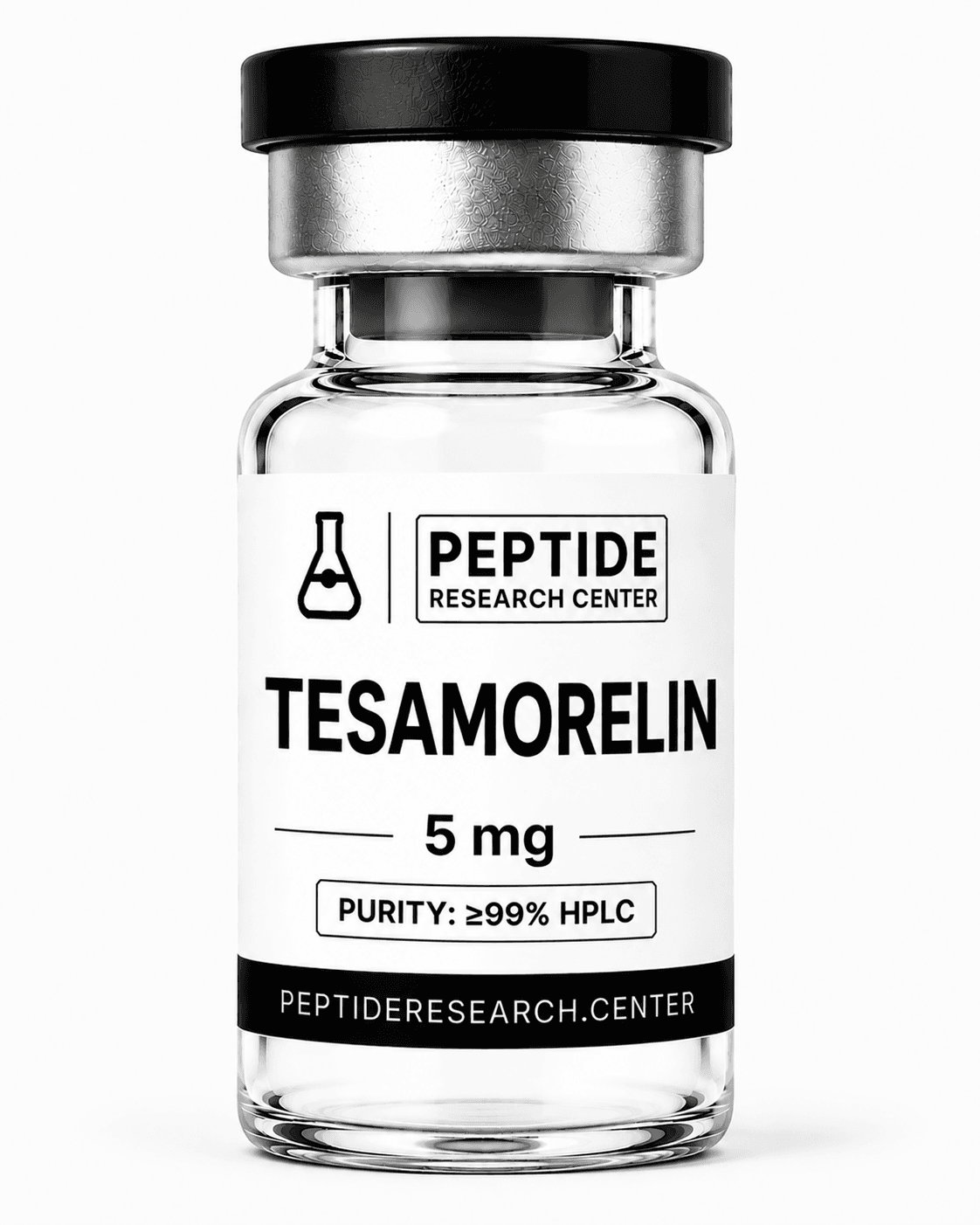
Tesamorelin
GHRH analog • Growth hormone axis research
Tesamorelin is a synthetic growth-hormone-releasing hormone (GHRH) analog studied in research on the GH/IGF-1 axis and adipose-tissue metabolism.
One-time payment, no recurring charge. Ships together.
SKU: PRC-TESA-5
Research Use Only. Not for human or veterinary use. By ordering you confirm you are a qualified researcher.
Purity Verification
HPLC Purity
>99% HPLC
Mass Spec Verified
ESI-MS
Certificate of Analysis
Per batch
Preparation & Handling
Supplied as lyophilized powder. Store unreconstituted vials at -20 °C, protected from light. Reconstitute with bacteriostatic or sterile water; once reconstituted, store at 2–8 °C and use within the validated stability window. Do not freeze-thaw repeatedly. For laboratory research use only.
The Science Behind Tesamorelin
Tesamorelin is the GHRH analogue most extensively validated in controlled human trials — a stabilized form of growth-hormone-releasing hormone studied for its effects on the GH/IGF-1 axis, visceral fat, and liver metabolism, and the only agent in its class approved for a specific indication (HIV-associated lipodystrophy). The summaries below describe that literature on the tesamorelin molecule, with citations, for scientific reference only; the research-grade peptide supplied here is for in-vitro and laboratory use, not for human or veterinary use.
Overview
Tesamorelin is a stabilized synthetic analogue of growth-hormone-releasing hormone (GHRH) that stimulates endogenous growth hormone — and downstream IGF-1 — secretion from the pituitary. It is the GHRH analogue most studied in controlled human trials and the only agent in this class approved (in people with HIV-associated lipodystrophy) for reducing excess visceral abdominal fat. [1][4]
Molecular design & stabilisation
Tesamorelin is built on the full 44–amino-acid sequence of human GHRH(1-44) with an N-terminal trans-3-hexenoyl modification. [4] This acylation protects the peptide's N-terminus against rapid enzymatic cleavage (notably by DPP-4), giving it greater metabolic stability and a longer duration of GHRH-receptor activity than native GHRH while preserving the natural, pulsatile pattern of GH release. [1]
Mechanism: the GHRH axis
As a GHRH-receptor agonist on pituitary somatotrophs, tesamorelin promotes pulsatile GH release and raises circulating IGF-1. [1] Because it stimulates the body's own GH production rather than supplying exogenous GH, the literature frames it as acting “upstream,” within physiological feedback — distinct from recombinant GH itself. [4]
Visceral-fat clinical research
In two phase-3 trials and their pooled analysis, daily tesamorelin significantly reduced visceral adipose tissue and waist circumference over 26 weeks in people with HIV-associated excess abdominal fat, with maintenance during extension phases. [1] Subsequent analyses examined which baseline characteristics predicted visceral-fat response. [4]
Metabolic & hepatic research
Research has also examined tesamorelin in non-alcoholic fatty liver disease (NAFLD): a randomized, placebo-controlled trial reported reduced liver fat, and hepatic transcriptomic analysis suggested shifts in pathways related to inflammation and fibrosis. [2] More recent randomized work evaluated tesamorelin in people with HIV on modern integrase-inhibitor regimens, extending the earlier evidence base to current antiretroviral therapy. [3]
Research-use context
The clinical findings above describe the approved medicine in defined patient populations. The material supplied here is research-grade and intended solely for in-vitro and laboratory study by qualified professionals — it is not formulated, dosed, or authorised for use in humans or animals, and nothing here is a therapeutic claim. [4]
References
- 1.Falutz J, Mamputu JC, Potvin D, et al. Effects of tesamorelin (TH9507), a growth hormone-releasing factor analog, in HIV-infected patients with excess abdominal fat: a pooled analysis of two phase 3 trials. J Clin Endocrinol Metab. 2010;95(9):4291–4304.
- 2.Fourman LT, Billingsley JM, Agyapong G, et al. Effects of tesamorelin on hepatic transcriptomic signatures in HIV-associated NAFLD. JCI Insight. 2020;5(16):e140134.
- 3.Russo SC, Ockene MW, Arpante AK, et al. Efficacy and safety of tesamorelin in people with HIV on integrase inhibitors. AIDS. 2024;38(12):1758–1764.
- 4.Spooner LM, Olin JL. Tesamorelin: a growth hormone-releasing factor analogue for HIV-associated lipodystrophy. Ann Pharmacother. 2012;46(2):240–247.
Research Use Only. The information above is provided for educational and reference purposes only and summarizes third-party laboratory and preclinical research. Peptide Research Center products are intended solely for in-vitro and laboratory research by qualified professionals — not for human or veterinary use, diagnosis, or treatment. Nothing here constitutes medical advice or a therapeutic claim.
Related Research Compounds
 >99% HPLC
CJC-1295
GHRH analog (No-DAC / Ipamorelin blend) • GH axis research
 >99% HPLC
Ipamorelin
Selective GH secretagogue • GH axis research
>99% HPLCTesamorelin
GHRH analog • Growth hormone axis research