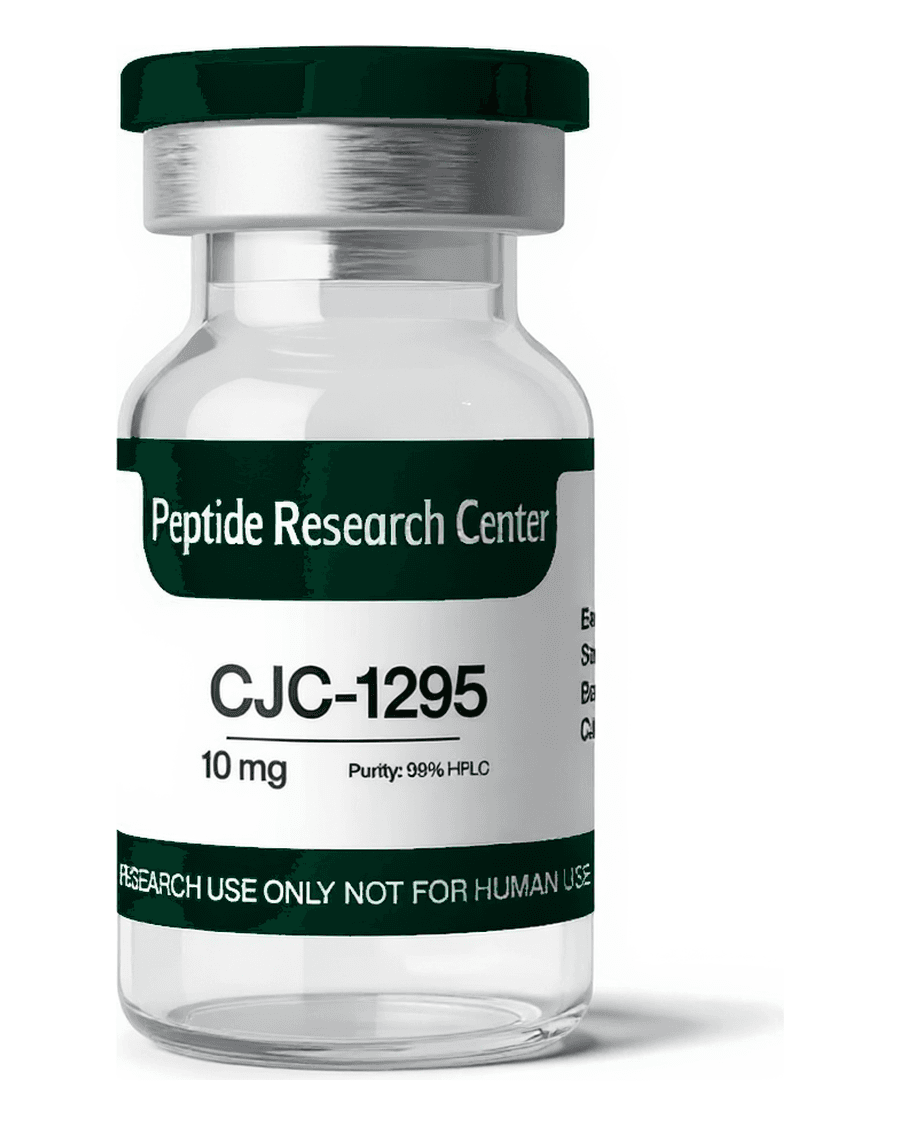
CJC-1295
GHRH analog (No-DAC / Ipamorelin blend) • GH axis research
CJC-1295 is a synthetic GHRH analog studied in growth-hormone-axis research. Offered as a No-DAC formulation and as a co-formulated blend with Ipamorelin.
Currently unavailable
This research compound is not available for purchase right now. Please check back soon.
Purity Verification
HPLC Purity
>99% HPLC
Mass Spec Verified
ESI-MS
Certificate of Analysis
Per batch
Preparation & Handling
Supplied as lyophilized powder. Store unreconstituted vials at -20 °C, protected from light. Reconstitute with bacteriostatic or sterile water; once reconstituted, store at 2–8 °C and use within the validated stability window. Do not freeze-thaw repeatedly. For laboratory research use only.
The Science Behind CJC-1295
CJC-1295 is a long-acting analogue of growth-hormone-releasing hormone (GHRH), built on a modified GHRH(1-29) backbone and engineered for an extended duration of action. The research literature centres on its prolonged stimulation of GH and IGF-1, the distinction between its “No-DAC” and albumin-binding “DAC” forms, and its analytical detection in anti-doping work. The summaries below describe that literature with citations, for research context only — this material is for in-vitro and laboratory use, not for human or veterinary use.
Overview
CJC-1295 is a synthetic analogue of growth-hormone-releasing hormone (GHRH). Its peptide core is a modified GHRH(1-29) sequence — the same active fragment as sermorelin — carrying amino-acid substitutions that resist enzymatic degradation, so it stimulates GH and IGF-1 secretion for longer than native GHRH. [1][3]
No-DAC vs DAC formulations
Two forms appear in the literature. The “No-DAC” form (often called Modified GRF 1-29) is the bare, stabilised GHRH(1-29) analogue with a relatively short half-life, used when researchers want a discrete, shorter GHRH stimulus. The “DAC” form adds a Drug Affinity Complex — a reactive linker that binds covalently to circulating albumin — which extends the half-life to roughly a week. [1] The material described here is the No-DAC form.
Mechanism & pharmacology
In a study in healthy adults, administration of CJC-1295 produced sustained, dose-dependent increases in GH and IGF-1 over a prolonged period, consistent with its design as a long-acting GHRH-receptor agonist that amplifies the body's own pulsatile GH output rather than supplying exogenous GH. [1]
Analytical & regulatory context
CJC-1295 has been characterised analytically (for example by LC-HRMS/MS) in the anti-doping literature, where it was identified in an unknown pharmaceutical preparation, and it is listed as a prohibited substance by WADA owing to its GH-releasing activity. [2] This analytical work makes it a reference analyte in sports-testing method development.
Research-use context
CJC-1295 is a research compound, not an approved medicine. The material supplied here is intended solely for in-vitro and laboratory study by qualified professionals — it is not formulated, dosed, or authorised for use in humans or animals, and nothing here is a therapeutic claim.
References
- 1.Teichman SL, Neale A, Lawrence B, et al. Prolonged stimulation of growth hormone (GH) and insulin-like growth factor I secretion by CJC-1295, a long-acting analog of GH-releasing hormone, in healthy adults. J Clin Endocrinol Metab. 2006;91(3):799–805.
- 2.Henninge J, Pepaj M, Hullstein I, Hemmersbach P. Identification of CJC-1295, a growth-hormone-releasing peptide, in an unknown pharmaceutical preparation. Drug Test Anal. 2010;2(11-12):647–650.
- 3.Cervini LA, Donaldson CJ, Koerber SC, Vale WW, Rivier JE. Human growth hormone-releasing hormone hGHRH(1-29)-NH2: systematic structure-activity relationship studies. J Med Chem. 1998;41(5):717–727.
Research Use Only. The information above is provided for educational and reference purposes only and summarizes third-party laboratory and preclinical research. Peptide Research Center products are intended solely for in-vitro and laboratory research by qualified professionals — not for human or veterinary use, diagnosis, or treatment. Nothing here constitutes medical advice or a therapeutic claim.
Related Research Compounds
 >99% HPLC
Ipamorelin
Selective GH secretagogue • GH axis research
 >99% HPLC
Tesamorelin
GHRH analog • Growth hormone axis research
>99% HPLCCJC-1295
GHRH analog (No-DAC / Ipamorelin blend) • GH axis research