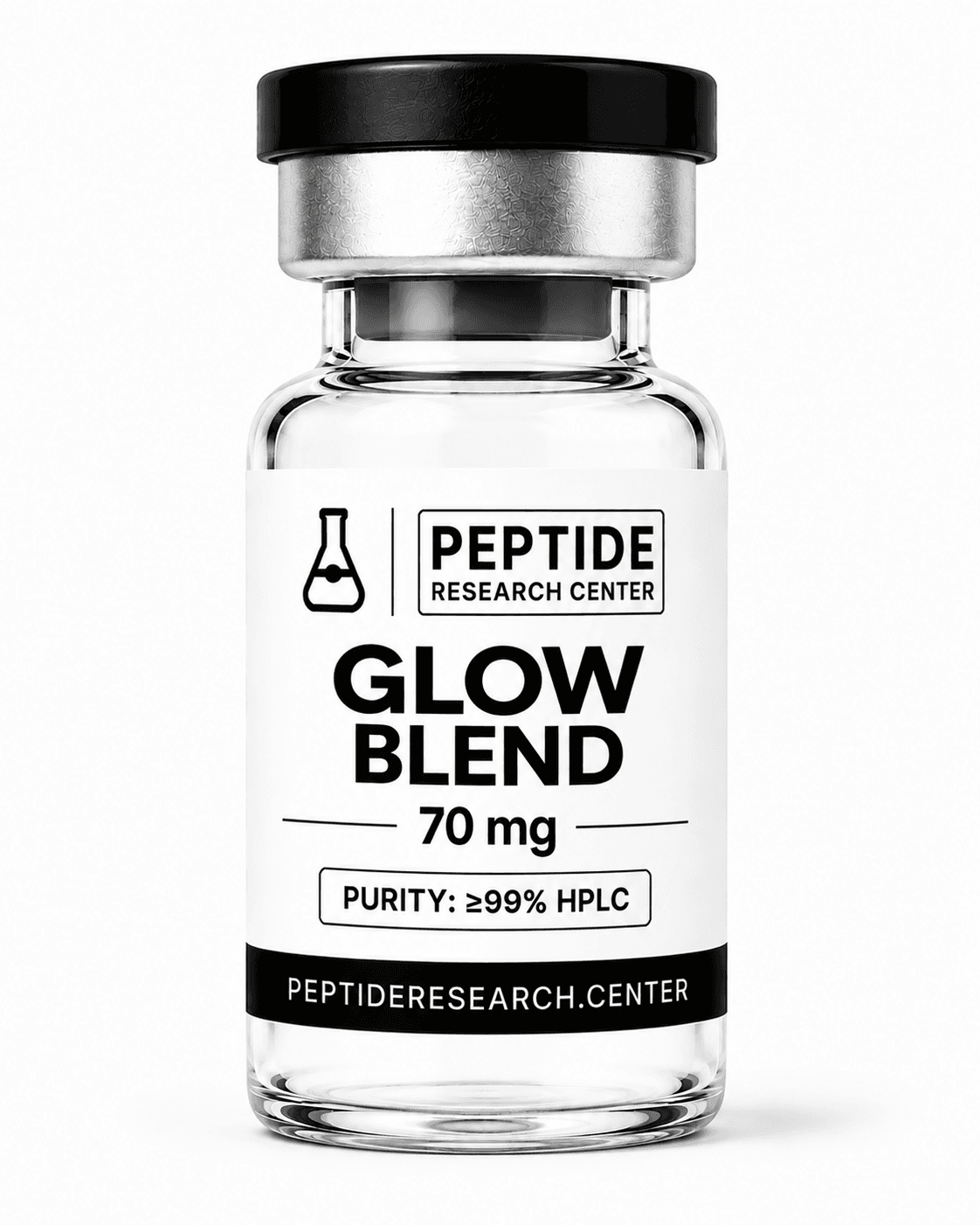
Glow Blend
BPC-157 + TB-500 + GHK-Cu • Skin & recovery research
The Glow Blend pairs BPC-157 and TB-500 with the copper peptide GHK-Cu (70 mg total), a combination studied in skin, collagen, and recovery research models.
One-time payment, no recurring charge. Ships together.
SKU: PRC-GLOW-70
Research Use Only. Not for human or veterinary use. By ordering you confirm you are a qualified researcher.
Purity Verification
HPLC Purity
>99% HPLC
Mass Spec Verified
ESI-MS
Certificate of Analysis
Per batch
Preparation & Handling
Supplied as lyophilized powder. Store unreconstituted vials at -20 °C, protected from light. Reconstitute with bacteriostatic or sterile water; once reconstituted, store at 2–8 °C and use within the validated stability window. Do not freeze-thaw repeatedly. For laboratory research use only.
The Science Behind Glow Blend
The Glow Blend co-formulates three research peptides with complementary profiles — BPC-157 and TB-500 (thymosin β4), both studied in tissue repair, and GHK-Cu, a copper tripeptide central to dermal and extracellular-matrix research. The pairing is designed for studies that combine recovery-model peptides with a skin- and collagen-oriented compound. The science is best understood per component, summarised below with citations. Supplied as a co-lyophilized blend for in-vitro and laboratory research only — combination effects in any organism have not been established.
About this blend
The Glow Blend combines BPC-157, TB-500 (thymosin β4), and GHK-Cu, co-lyophilized for studies that pair tissue-repair profiles with dermal and extracellular-matrix research. Because it is a mixture rather than a single molecule, it carries no single CAS number or formula; its research context is best read alongside the dedicated BPC-157, TB-500, and GHK-Cu listings.
Rationale for the combination
Each component is studied for a distinct but complementary process: BPC-157 for soft-tissue and vascular repair, TB-500/Tβ4 for cell migration and regeneration, and GHK-Cu for collagen and extracellular-matrix remodeling in skin. [1][3][5] This rationale is mechanistic and drawn from the separate single-agent literatures; controlled studies establishing a specific advantage of the three-way combination are limited, and none support human use.
BPC-157 component
BPC-157 is a stable gastric pentadecapeptide studied in preclinical models of musculoskeletal soft-tissue and dermal wound healing, with a recurring proposed mechanism of promoting angiogenesis. [1][2]
TB-500 component
TB-500 corresponds to thymosin β4, the major actin-sequestering peptide in mammalian cells, studied as a multifunctional regenerative peptide tied to cell migration and to endothelial/vascular remodeling. [3][4]
GHK-Cu component
GHK-Cu is a naturally occurring copper-binding tripeptide studied in skin remodeling, collagen and glycosaminoglycan synthesis, [5] and as a broad modulator of tissue-repair gene-expression programmes. [6]
Research-use context
All three components are research compounds supported predominantly by animal and in-vitro evidence. This blend is supplied strictly for in-vitro and laboratory research by qualified professionals — it is not formulated, dosed, or authorised for use in humans or animals, and nothing here is a therapeutic or cosmetic-efficacy claim.
References
- 1.Gwyer D, Wragg NM, Wilson SL. Gastric pentadecapeptide body protection compound BPC 157 and its role in accelerating musculoskeletal soft tissue healing. Cell Tissue Res. 2019;377(2):153–159.
- 2.Seiwerth S, Milavić M, Vukojević J, et al. Stable gastric pentadecapeptide BPC 157 and wound healing. Front Pharmacol. 2021;12:627533.
- 3.Goldstein AL, Hannappel E, Sosne G, et al. Thymosin β4: a multi-functional regenerative peptide. Expert Opin Biol Ther. 2012;12(1):37–51.
- 4.Dubé KN, Smart N. Thymosin β4 and the vasculature: multiple roles in development, repair and protection against disease. Expert Opin Biol Ther. 2018;18(sup1):131–139.
- 5.Pickart L. The human tri-peptide GHK and tissue remodeling. J Biomater Sci Polym Ed. 2008;19(8):969–988.
- 6.Pickart L, Vasquez-Soltero JM, Margolina A. GHK peptide as a natural modulator of multiple cellular pathways in skin regeneration. Biomed Res Int. 2015;2015:648108.
Research Use Only. The information above is provided for educational and reference purposes only and summarizes third-party laboratory and preclinical research. Peptide Research Center products are intended solely for in-vitro and laboratory research by qualified professionals — not for human or veterinary use, diagnosis, or treatment. Nothing here constitutes medical advice or a therapeutic claim.
Related Research Compounds
 >99% HPLC
GHK-Cu
Copper tripeptide • Skin & collagen research
 >99% HPLC
BPC-157
Pentadecapeptide • Tissue & gut research
 >99% HPLC
Wolverine Blend
TB-500 + BPC-157 • Combined recovery research