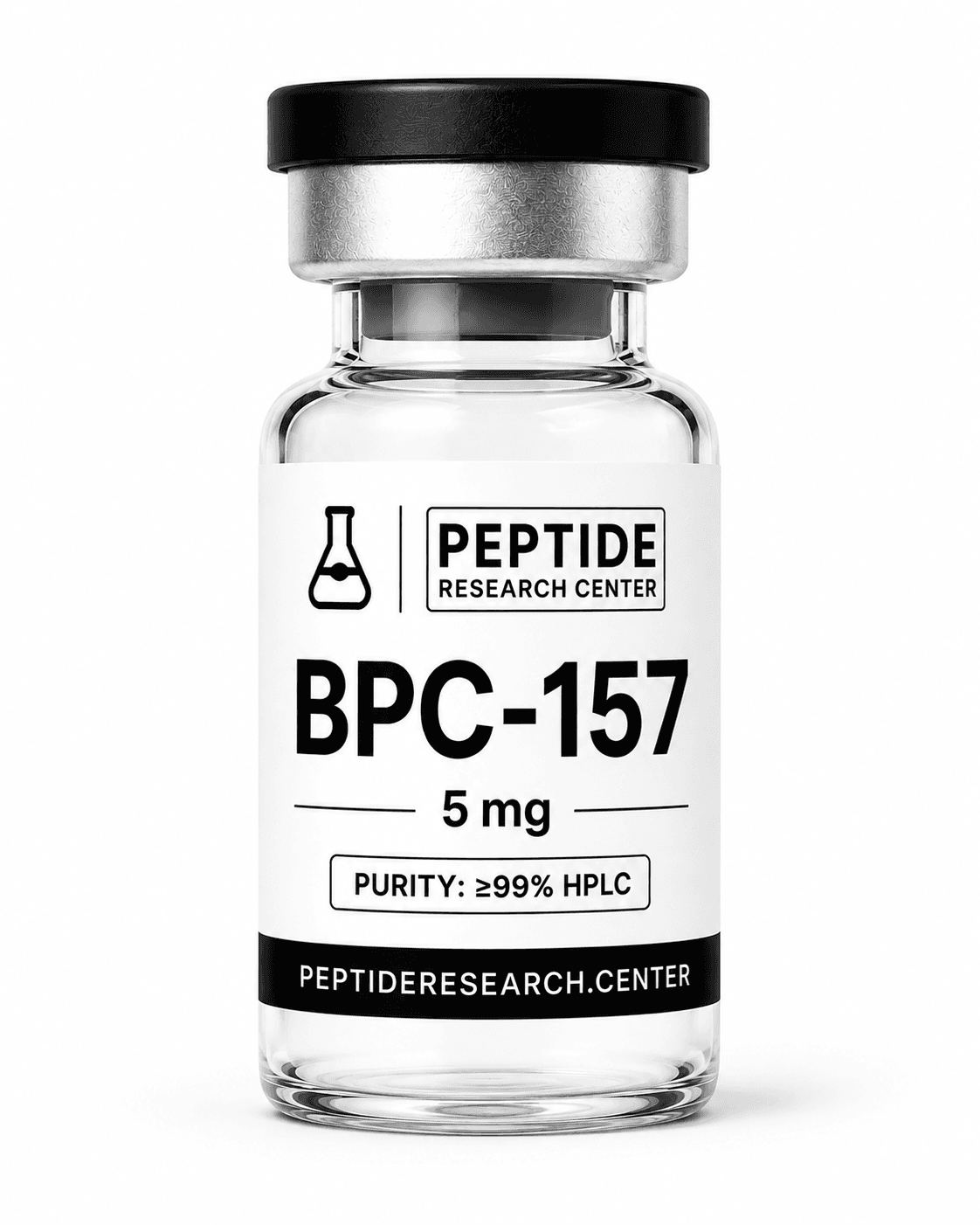
BPC-157
Pentadecapeptide • Tissue & gut research
BPC-157 is a synthetic pentadecapeptide derived from a sequence in human gastric juice. It is one of the most widely studied research peptides for models of tissue repair, angiogenesis, and gastrointestinal protection.
One-time payment, no recurring charge. Ships together.
SKU: PRC-BPC157-5
Research Use Only. Not for human or veterinary use. By ordering you confirm you are a qualified researcher.
Purity Verification
HPLC Purity
>99% HPLC
Mass Spec Verified
ESI-MS
Certificate of Analysis
Batch BPC-157-248
Preparation & Handling
Supplied as lyophilized powder. Store unreconstituted vials at -20 °C, protected from light. Reconstitute with bacteriostatic or sterile water; once reconstituted, store at 2–8 °C and use within the validated stability window. Do not freeze-thaw repeatedly. For laboratory research use only.
The Science Behind BPC-157
BPC-157 is one of the most extensively studied peptides in the preclinical recovery literature. Across rodent and in-vitro models, research groups have examined it in the context of gastrointestinal cytoprotection, angiogenesis through the VEGFR2 pathway, tendon- and ligament-fibroblast behaviour, dermal wound healing, and the gut–brain axis. The summaries below outline what those laboratory and animal studies have reported, with citations to the primary literature. All such work is preclinical — efficacy in humans has not been established — and these materials are intended solely for laboratory research.
Overview
BPC-157 is a synthetic 15–amino-acid peptide (a “pentadecapeptide”) corresponding to a partial sequence of body protection compound (BPC), a protein isolated from human gastric juice. In the research literature it is described as unusually stable — reportedly resistant to degradation in gastric acid — which is one reason it is so widely used as a reference “cytoprotective” compound in preclinical work. No single high-affinity receptor has been firmly established; instead, reviews characterise its activity as pleiotropic, spanning vascular, connective-tissue, gastrointestinal, and nervous-system models, and frequently framed in terms of growth-factor and nitric-oxide signalling. [1][3] The overwhelming majority of this evidence comes from rodent and in-vitro studies; efficacy has not been established in humans. [1]
Gastrointestinal cytoprotection models
The earliest and most extensive BPC-157 literature concerns the gastrointestinal tract. In rodent models of gastric and intestinal lesions, researchers have reported preservation of mucosal integrity and accelerated closure of experimentally induced ulcers and fistulas, effects discussed in the framework of Robert's “cytoprotection” and Selye's stress-response biology. [3][4] Proposed mechanisms in these reports centre on the nitric-oxide (NO) system and on maintenance of vascular and epithelial function under stress. This gastrointestinal focus is consistent with the peptide's origin as a gastric-juice–derived sequence. [3]
Angiogenesis & the VEGFR2 pathway
A recurring theme across the in-vitro literature is angiogenesis — the formation of new blood vessels. In cultured human umbilical vein endothelial cells (HUVECs), studies have reported increased proliferation, migration, and tube formation alongside upregulation of vascular endothelial growth factor (VEGF). [6] Mechanistic work in endothelial cells and chick-embryo models has associated these effects with activation and up-regulation of VEGF receptor-2 (VEGFR2) and downstream nitric-oxide signalling. [5] In injury models this pro-angiogenic activity is often linked to the idea of vascular “running” — directed outgrowth of vessels toward ischemic or damaged tissue. [5][6]
Tendon, ligament & muscle models
Because tendons and ligaments are poorly vascularised and slow to repair, they are a frequent subject of BPC-157 research. In rat tendon studies, the peptide has been reported to promote outgrowth and migration of tendon fibroblasts, improve cell survival under oxidative (H₂O₂) stress, and increase F-actin formation. [7] Investigators have linked the migratory effect to phosphorylation of focal adhesion kinase (FAK) and paxillin — the “FAK–paxillin pathway” — without changing total protein levels. [7] Reviews of the broader musculoskeletal literature describe consistent healing signals across tendon, ligament, bone, and skeletal-muscle injury models, and separate work has examined striated, smooth, and cardiac muscle preparations. [1][8]
Wound healing & skin models
In dermal wound models — including incisional, excisional, and alkali-burn injuries in rodents — BPC-157 has been associated with faster wound closure, improved granulation-tissue formation, re-epithelialisation, and collagen organisation. [2][6] At the signalling level, one study reported regulation of extracellular signal-regulated kinases 1/2 (ERK1/2) and their downstream targets c-Fos, c-Jun, and Egr-1 — transcriptional regulators tied to cell growth, migration, and angiogenesis. [6] As elsewhere, these are controlled laboratory observations in animal and cell-culture systems rather than clinical findings. [2]
Nervous system & the gut–brain axis
Preclinical work has extended to the central and peripheral nervous system. In a murine traumatic-brain-injury model, researchers reported attenuated lesion severity and reduced brain edema in BPC-157–treated animals. [9] A dedicated review summarises additional nervous-system models, including nerve-injury and ischemia paradigms. [10] More recent literature situates these observations within a proposed bidirectional gut–brain / brain–gut axis, consistent with the peptide's gastrointestinal origins. [11]
Stability & research use
Two properties make BPC-157 a common reference compound in peptide research: its reported stability (including in gastric juice) and the breadth of models in which it has been studied. [1][3] The literature is dominated by a relatively small number of research groups, and reviewers consistently note that findings are preclinical and not yet confirmed in humans. [1] These materials are supplied strictly for in-vitro and laboratory research; nothing here should be read as a therapeutic claim.
References
- 1.Gwyer D, Wragg NM, Wilson SL. Gastric pentadecapeptide body protection compound BPC 157 and its role in accelerating musculoskeletal soft tissue healing. Cell Tissue Res. 2019;377(2):153–159.
- 2.Seiwerth S, Milavić M, Vukojević J, et al. Stable gastric pentadecapeptide BPC 157 and wound healing. Front Pharmacol. 2021;12:627533.
- 3.Sikirić P, Hahm KB, Blagaić AB, et al. Stable gastric pentadecapeptide BPC 157, Robert's cytoprotection/adaptive cytoprotection/organoprotection, and Selye's stress coping response. Gut Liver. 2020.
- 4.Sikirić P, Drmić D, Sever M, et al. Fistulas healing: stable gastric pentadecapeptide BPC 157 therapy. Curr Pharm Des. 2020.
- 5.Hsieh MJ, Liu HT, Wang CN, et al. Therapeutic potential of pro-angiogenic BPC157 is associated with VEGFR2 activation and up-regulation. J Mol Med (Berl). 2017;95(3):323–333.
- 6.Huang T, Zhang K, Sun L, et al. Body protective compound-157 enhances alkali-burn wound healing in vivo and promotes proliferation, migration, and angiogenesis in vitro. Drug Des Devel Ther. 2015;9:2485–2499.
- 7.Chang CH, Tsai WC, Lin MS, Hsu YH, Pang JH. The promoting effect of pentadecapeptide BPC 157 on tendon healing involves tendon outgrowth, cell survival, and cell migration. J Appl Physiol. 2011;110(3):774–780.
- 8.Staresinić M, Japjec M, Vraneš H, et al. Stable gastric pentadecapeptide BPC 157 and striated, smooth, and heart muscle. Biomedicines. 2022;10(12):3221.
- 9.Tudor M, Jandrić I, Marović A, et al. Traumatic brain injury in mice and pentadecapeptide BPC 157 effect. Regul Pept. 2010;160(1–3):26–32.
- 10.Vukojević J, Milavić M, Perović D, et al. Pentadecapeptide BPC 157 and the central nervous system. Neural Regen Res. 2022;17(3):482–487.
- 11.Sikirić P, Gojković S, Krezić I, et al. Stable gastric pentadecapeptide BPC 157 may recover brain–gut axis and gut–brain axis function. Pharmaceuticals (Basel). 2023;16(5):676.
Research Use Only. The information above is provided for educational and reference purposes only and summarizes third-party laboratory and preclinical research. Peptide Research Center products are intended solely for in-vitro and laboratory research by qualified professionals — not for human or veterinary use, diagnosis, or treatment. Nothing here constitutes medical advice or a therapeutic claim.
Facts & Questions
What purity standard applies?
Every batch is third-party tested by HPLC to ≥99% and ships with a downloadable Certificate of Analysis, searchable by lot number in our COA database.
How should it be reconstituted?
Reconstitute with bacteriostatic water and store refrigerated. Reconstitution volume depends on the concentration required by your protocol.
Related Research Compounds
 >99% HPLC
TB-500
Thymosin β4 fragment • Recovery research
 >99% HPLC
Wolverine Blend
TB-500 + BPC-157 • Combined recovery research
 >99% HPLC
GHK-Cu
Copper tripeptide • Skin & collagen research