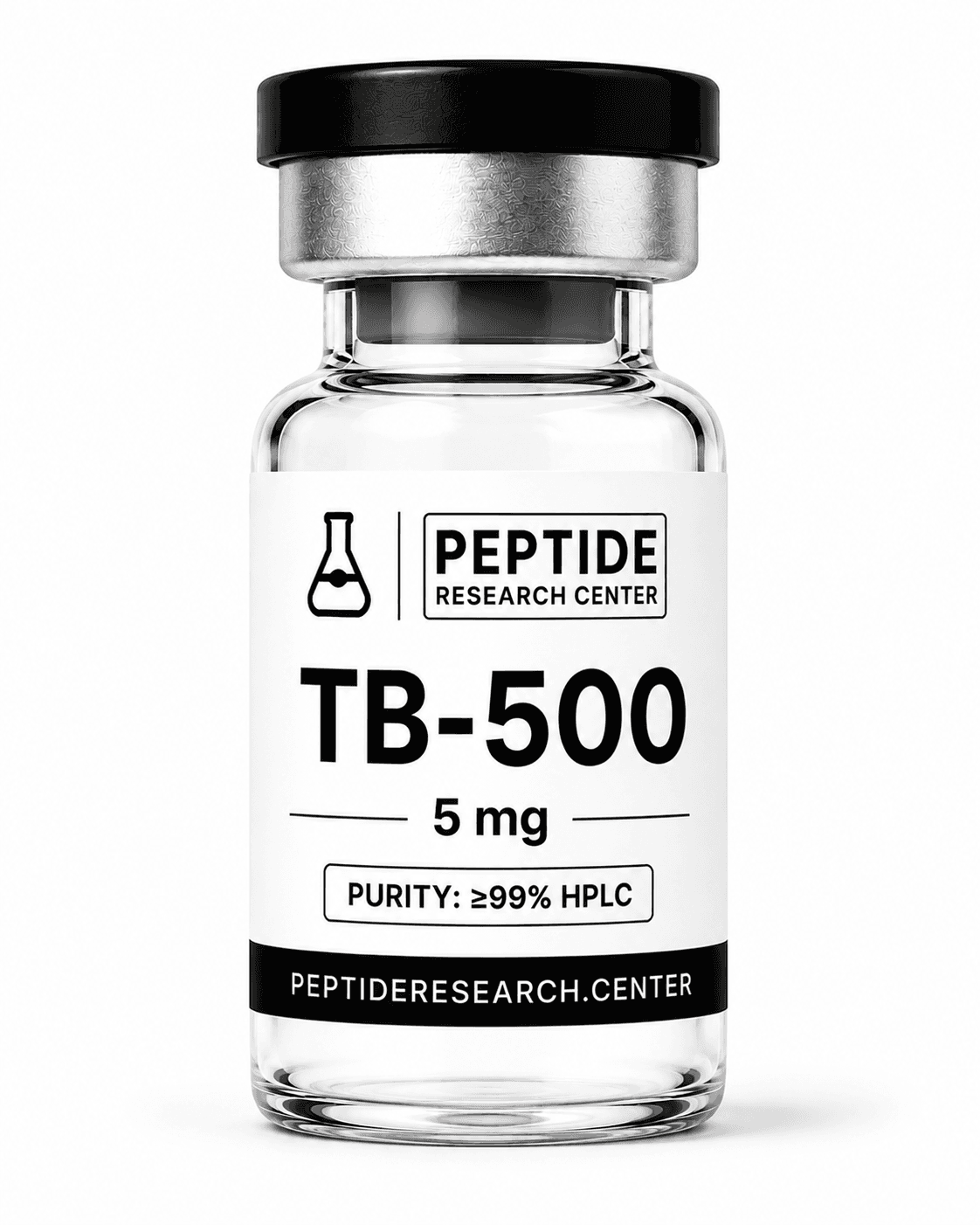
TB-500
Thymosin β4 fragment • Recovery research
TB-500 is a synthetic peptide corresponding to the active region of Thymosin Beta-4. It is studied in models of cell migration, actin regulation, and tissue recovery.
One-time payment, no recurring charge. Ships together.
SKU: PRC-TB500-5
Research Use Only. Not for human or veterinary use. By ordering you confirm you are a qualified researcher.
Purity Verification
HPLC Purity
>99% HPLC
Mass Spec Verified
ESI-MS
Certificate of Analysis
Batch TB-500-112
Preparation & Handling
Supplied as lyophilized powder. Store unreconstituted vials at -20 °C, protected from light. Reconstitute with bacteriostatic or sterile water; once reconstituted, store at 2–8 °C and use within the validated stability window. Do not freeze-thaw repeatedly. For laboratory research use only.
The Science Behind TB-500
TB-500 corresponds to thymosin β4 (Tβ4), one of the most studied regenerative peptides in the preclinical literature and the principal actin-sequestering molecule in mammalian cells. Research groups have examined it across cytoskeletal dynamics, endothelial migration and angiogenesis, dermal/corneal/cardiac repair models, and nervous-system injury, and Tβ4 has advanced into ophthalmic clinical trials. The summaries below describe those laboratory, animal, and trial findings with citations to the primary literature; all are presented for research context only — these materials are not for human or veterinary use.
Overview
TB-500 corresponds to thymosin β4 (Tβ4), an N-acetylated peptide of roughly 43 amino acids that is the major G-actin-sequestering molecule in mammalian cells. Tβ4 is released by platelets and other cell types after injury, and reviews describe it as a multifunctional regenerative peptide acting on cell migration, inflammation, and apoptosis. [1][2] In commercial research material the name “TB-500” is used for the synthetic peptide carrying this actin-binding activity. [1]
Mechanism: actin sequestration & the cytoskeleton
The defining biochemical property of the β-thymosins is high-affinity binding to monomeric (G-)actin, which removes actin from the dynamic assembly–disassembly cycle of the cytoskeleton. [2] In activated and migrating cells this sequestering activity is linked in the literature to cytoskeletal remodeling, directional cell migration, and the cellular machinery underlying wound repair and angiogenesis. [2]
Angiogenesis & the vasculature
A dedicated body of work examines Tβ4 in vascular biology. Reviews report that exogenous Tβ4 can enhance endothelial-cell migration, capillary formation, and pericyte recruitment, and that it participates in vasculogenesis, angiogenesis, arteriogenesis, and extracellular-matrix remodeling in development and in injury models. [3] These vascular effects are frequently tied back to its cytoskeletal and paracrine signalling roles. [3]
Dermal & wound-healing models
In rodent models, Tβ4 has been associated with accelerated wound closure. One study using recombinant human Tβ4 reported promotion of full-thickness cutaneous wound healing in mice alongside lymphocyte proliferation. [4] Broader reviews summarise dermal, corneal, and pressure-/venous-ulcer models in which Tβ4 was associated with reduced inflammation and apoptosis and supported repair — observations that provided the rationale for subsequent human trials. [5]
Cardiac repair models
Cardiovascular research is a major theme of the Tβ4 literature. In a model of the injured adult heart, Tβ4 was reported to facilitate epicardial neovascularization by mobilising epicardium-derived progenitor cells and stabilising the vascular plexus through collateral-vessel growth. [6] Review work places these findings within wider efforts to apply Tβ4 — via injection or implant coatings — to post-myocardial-infarction repair and cardiac tissue engineering. [7]
Nervous-system research
Preclinical neuroscience studies have examined Tβ4 as a neuroprotective and neurorestorative candidate. In experimental traumatic-brain-injury and stroke paradigms, treatment was associated with angiogenesis, neurogenesis, and axonal remodeling, processes the authors connect to functional recovery in animal models. [8]
Ocular research & clinical translation
Unlike many research peptides, Tβ4 has progressed into human ophthalmic trials, where it has been investigated in the context of dry-eye disease and neurotrophic keratopathy. [9] This bench-to-bedside trajectory is specific to those clinical programmes and does not extend to the research-grade material supplied here, which remains for in-vitro and laboratory use only. [1]
References
- 1.Goldstein AL, Hannappel E, Sosne G, et al. Thymosin β4: a multi-functional regenerative peptide. Basic properties and clinical applications. Expert Opin Biol Ther. 2012;12(1):37–51.
- 2.Mannherz HG, Hannappel E. The β-thymosins: intracellular and extracellular activities of a versatile actin binding protein family. Cell Motil Cytoskeleton. 2009;66(10):839–851.
- 3.Dubé KN, Smart N. Thymosin β4 and the vasculature: multiple roles in development, repair and protection against disease. Expert Opin Biol Ther. 2018;18(sup1):131–139.
- 4.Li X, Zheng L, Peng F, et al. Recombinant thymosin beta 4 can promote full-thickness cutaneous wound healing. Protein Expr Purif. 2007;56(2):229–236.
- 5.Goldstein AL, Kleinman HK. Advances in the basic and clinical applications of thymosin β4. Expert Opin Biol Ther. 2015;15(Suppl 1):S139–S145.
- 6.Smart N, Risebro CA, Clark JE, et al. Thymosin β4 facilitates epicardial neovascularization of the injured adult heart. Ann N Y Acad Sci. 2010;1194:97–104.
- 7.Marks ED, Kumar A. Thymosin β4: roles in development, repair, and engineering of the cardiovascular system. Vitam Horm. 2016;102:227–249.
- 8.Xiong Y, Mahmood A, Meng Y, et al. Neuroprotective and neurorestorative effects of thymosin β4 treatment following experimental traumatic brain injury. Ann N Y Acad Sci. 2012;1270:51–58.
- 9.Sosne G. Thymosin beta 4 and the eye: the journey from bench to bedside. Expert Opin Biol Ther. 2018;18(sup1):99–104.
Research Use Only. The information above is provided for educational and reference purposes only and summarizes third-party laboratory and preclinical research. Peptide Research Center products are intended solely for in-vitro and laboratory research by qualified professionals — not for human or veterinary use, diagnosis, or treatment. Nothing here constitutes medical advice or a therapeutic claim.
Facts & Questions
Is TB-500 the same as Thymosin Beta-4?
TB-500 corresponds to the active actin-binding fragment of the larger Thymosin Beta-4 protein and is used as a research reference compound.