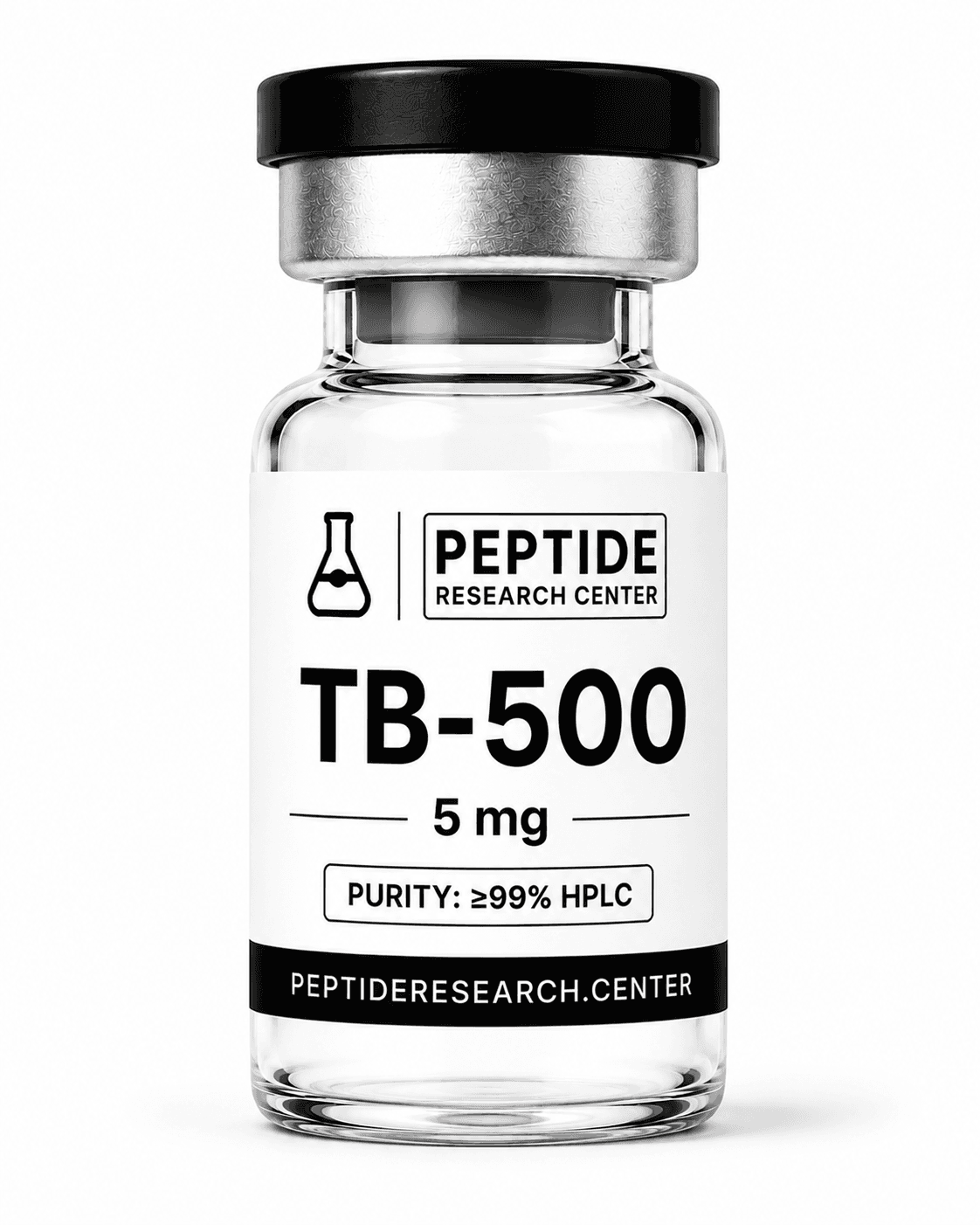
TB-500 (Thymosin β4) Research: Cellular Migration & Tissue Signaling
TB-500 is the research designation for a synthetic peptide corresponding to an active region of thymosin β4 (Tβ4), a small, naturally occurring actin-binding protein found in most cells. Because Tβ4 sits at the center of how cells build and dismantle their internal scaffolding, the peptide is widely used as a reference compound in preclinical studies of cell movement and tissue repair. Everything below summarizes third-party laboratory and animal research; it is provided for educational purposes only and describes no human or veterinary use.
The core mechanism: actin sequestration
Thymosin β4's defining biochemical job is binding monomeric (G-) actin — it is one of the cell's main actin-sequestering molecules, maintaining a pool of unpolymerized actin the cell can draw on. [1] Actin filaments are the rails a cell extends and retracts to change shape and move, so a molecule that regulates the available actin pool is positioned to influence migration, a recurring theme across the Tβ4 literature. [2]
Why migration matters in repair models
In wound- and injury-repair research, healing depends on cells — fibroblasts, endothelial cells, keratinocytes — migrating into the damaged area. Preclinical reviews of Tβ4 describe promotion of cell migration and reported effects on the rate of tissue repair in animal models, which is why the peptide recurs in recovery-research contexts. [1] As with all such work, these are controlled laboratory observations, not demonstrated clinical outcomes.
Angiogenesis and tissue models
Beyond migration, Tβ4 has been studied for angiogenesis — the formation of new blood vessels — including reports of facilitated neovascularization in injured-heart animal models. [3] This vascular angle is one reason the broader thymosin-β4 literature spans dermal, cardiac, and corneal repair paradigms in preclinical settings.
Primary literature & related
- Goldstein et al. — Thymosin β4: a multi-functional regenerative peptide (Expert Opin Biol Ther, 2012)
- Mannherz & Hannappel — The β-thymosins: a versatile actin-binding family (Cell Motil Cytoskeleton, 2009)
- Smart et al. — Tβ4 facilitates epicardial neovascularization (Ann N Y Acad Sci, 2010)
- TB-500 product page (full cited research)
- Wolverine blend (BPC-157 + TB-500)
Frequently Asked Questions
Is TB-500 the same as thymosin β4?
TB-500 is a synthetic peptide corresponding to an active region of the larger thymosin β4 protein. Researchers often use the names interchangeably, though they are not strictly identical molecules.
Why is it studied alongside BPC-157?
The two are associated with complementary repair-research pathways — TB-500 with actin/cell-migration biology, BPC-157 with angiogenesis and growth-factor signaling — so they frequently appear together in preclinical recovery studies.