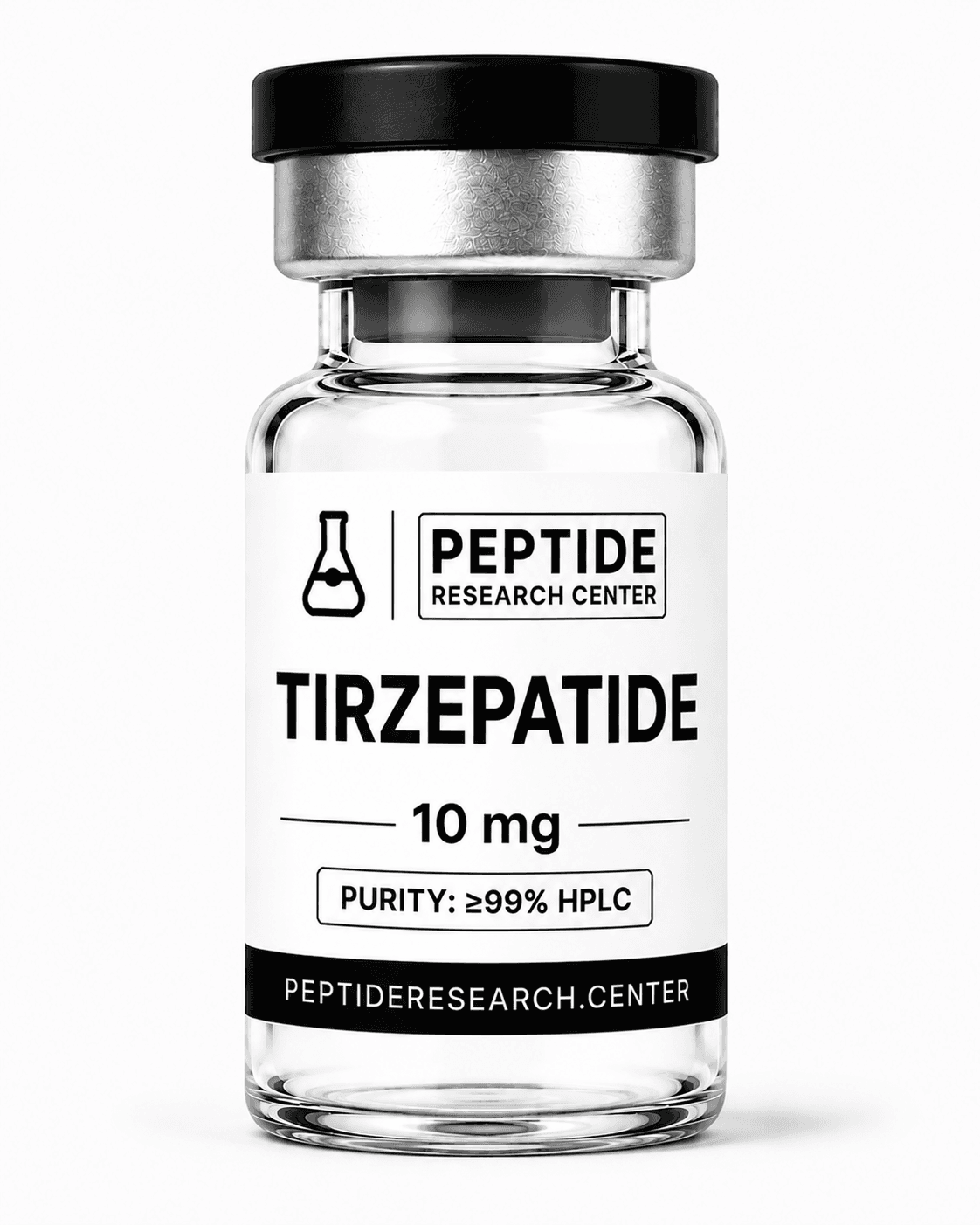
Tirzepatide
Dual GIP/GLP-1 receptor agonist • Metabolic research
Tirzepatide is a dual GIP and GLP-1 receptor agonist peptide, one of the most studied compounds in metabolic and incretin-pathway research.
One-time payment, no recurring charge. Ships together.
SKU: PRC-TIRZ-10
Research Use Only. Not for human or veterinary use. By ordering you confirm you are a qualified researcher.
Purity Verification
HPLC Purity
>99% HPLC
Mass Spec Verified
ESI-MS
Certificate of Analysis
Per batch
Preparation & Handling
Supplied as lyophilized powder. Store unreconstituted vials at -20 °C, protected from light. Reconstitute with bacteriostatic or sterile water; once reconstituted, store at 2–8 °C and use within the validated stability window. Do not freeze-thaw repeatedly. For laboratory research use only.
The Science Behind Tirzepatide
Tirzepatide is among the most intensively studied molecules in modern metabolic science — a single-molecule dual agonist of the GIP and GLP-1 receptors. The published literature spans its molecular design and biased receptor pharmacology, preclinical metabolic models, and a large phase-3 clinical-trial programme (SURPASS in type 2 diabetes, SURMOUNT in obesity). The summaries below describe that literature on the tirzepatide molecule, with citations. They are provided for scientific reference only: the research-grade peptide supplied here is not the approved medicine, is not formulated or dosed for any organism, and is for in-vitro and laboratory use only.
Overview
Tirzepatide is an engineered, acylated 39–amino-acid peptide that acts as a dual agonist at the glucose-dependent insulinotropic polypeptide (GIP) and glucagon-like peptide-1 (GLP-1) receptors — the first single-molecule co-agonist of its kind. Both receptors mediate glucose-dependent insulin secretion and are expressed in brain regions involved in appetite regulation, which is why the molecule is a frequent reference tool in incretin-pathway research. [1]
Molecular design & half-life
The peptide backbone incorporates non-natural residues (including 2-aminoisobutyric acid, Aib) for resistance to DPP-4 degradation, together with a C20 fatty-diacid chain that promotes albumin binding and a long circulating half-life — the basis for once-weekly dosing in studies. [2] This places tirzepatide among the “acylated” incretin analogues rather than the native peptide hormones.
Mechanism: biased dual agonism
Receptor-pharmacology studies characterise tirzepatide as an “imbalanced” or biased dual agonist, with signalling profiles at the GIP and GLP-1 receptors that differ from native ligands and from selective GLP-1 agonists. [3] Researchers hypothesise that this biased signalling contributes to metabolic effects beyond those of GLP-1 receptor agonism alone. [3]
Preclinical pharmacology
In the discovery and preclinical literature, tirzepatide (originally designated LY3298176) was profiled for receptor binding and downstream signalling in vitro and for glucose- and weight-related endpoints in animal metabolic models, establishing the rationale for clinical development. [2]
Clinical research — glycaemic control
In the phase-3 SURPASS programme, tirzepatide was studied in type 2 diabetes: SURPASS-1 evaluated it as monotherapy versus placebo, [4] and SURPASS-2 compared it head-to-head with semaglutide, with investigators reporting greater reductions in glycated haemoglobin in the trial populations. [5]
Clinical research — body weight
The SURMOUNT programme extended study to chronic weight management; in SURMOUNT-1, tirzepatide was investigated in adults with obesity, with the trial reporting dose-dependent reductions in body weight versus placebo. [6] These are outcomes from controlled clinical trials of the approved pharmaceutical product in enrolled patients.
Research-use context
It is essential to distinguish the published clinical literature on the tirzepatide molecule from the research-grade material offered here. This product is supplied for in-vitro and laboratory research only; it is not the approved medicine, is not sterile-formulated or dosed for administration, and nothing in these summaries should be read as instructions for — or a claim about — use in humans or animals. [1]
References
- 1.Nauck MA, D’Alessio DA. Tirzepatide, a dual GIP/GLP-1 receptor co-agonist for the treatment of type 2 diabetes with unmatched effectiveness regarding glycaemic control and body weight reduction. Cardiovasc Diabetol. 2022;21(1):169.
- 2.Coskun T, Sloop KW, Loghin C, et al. LY3298176, a novel dual GIP and GLP-1 receptor agonist for the treatment of type 2 diabetes mellitus: from discovery to clinical proof of concept. Mol Metab. 2018;18:3–14.
- 3.Willard FS, Douros JD, Gabe MB, et al. Tirzepatide is an imbalanced and biased dual GIP and GLP-1 receptor agonist. JCI Insight. 2020;5(17):e140532.
- 4.Rosenstock J, Wysham C, Frías JP, et al. Efficacy and safety of a novel dual GIP and GLP-1 receptor agonist tirzepatide in patients with type 2 diabetes (SURPASS-1): a double-blind, randomised, phase 3 trial. Lancet. 2021;398(10295):143–155.
- 5.Frías JP, Davies MJ, Rosenstock J, et al. Tirzepatide versus semaglutide once weekly in patients with type 2 diabetes (SURPASS-2). N Engl J Med. 2021;385(6):503–515.
- 6.Jastreboff AM, Aronne LJ, Ahmad NN, et al. Tirzepatide once weekly for the treatment of obesity (SURMOUNT-1). N Engl J Med. 2022;387(3):205–216.
Research Use Only. The information above is provided for educational and reference purposes only and summarizes third-party laboratory and preclinical research. Peptide Research Center products are intended solely for in-vitro and laboratory research by qualified professionals — not for human or veterinary use, diagnosis, or treatment. Nothing here constitutes medical advice or a therapeutic claim.
Facts & Questions
How is it characterized?
Identity and ≥99% purity are confirmed by HPLC and mass spectrometry, documented on the batch COA.