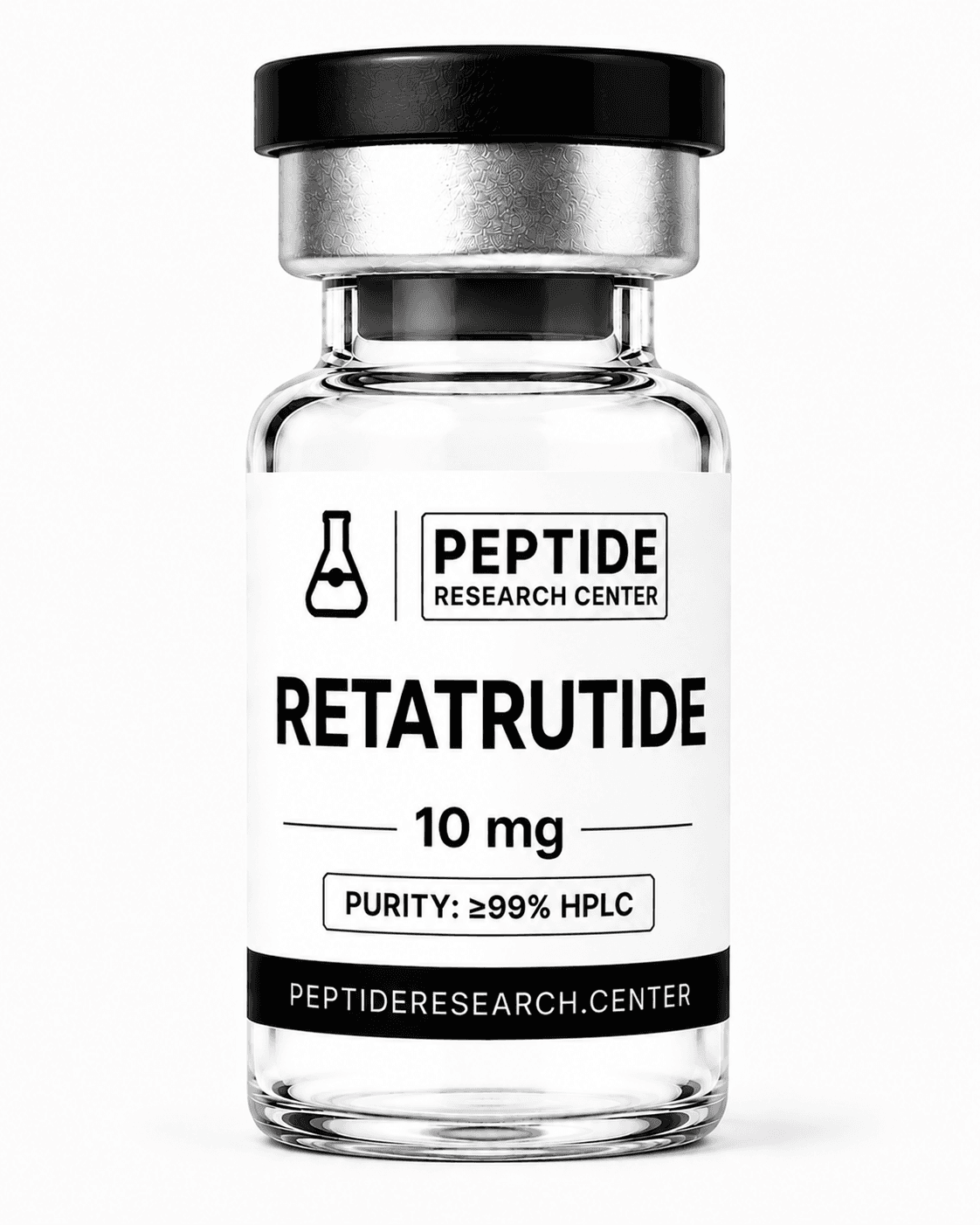
Retatrutide
Triple GIP/GLP-1/glucagon agonist • Metabolic research
Retatrutide is a triple agonist peptide targeting the GIP, GLP-1, and glucagon receptors — a leading reference compound in next-generation metabolic-pathway research.
One-time payment, no recurring charge. Ships together.
SKU: PRC-RETA-10
Research Use Only. Not for human or veterinary use. By ordering you confirm you are a qualified researcher.
Purity Verification
HPLC Purity
>99% HPLC
Mass Spec Verified
ESI-MS
Certificate of Analysis
Per batch
Preparation & Handling
Supplied as lyophilized powder. Store unreconstituted vials at -20 °C, protected from light. Reconstitute with bacteriostatic or sterile water; once reconstituted, store at 2–8 °C and use within the validated stability window. Do not freeze-thaw repeatedly. For laboratory research use only.
The Science Behind Retatrutide
Retatrutide is an investigational triple agonist of the GLP-1, GIP, and glucagon receptors — a leading molecule in the next generation of incretin metabolic research. Its published literature ranges from the discovery paper characterising its receptor pharmacology, through preclinical models, to a phase-2 clinical trial and subsequent meta-analyses. Unlike tirzepatide and semaglutide, retatrutide is not an approved medicine; it remains in clinical development. The summaries below describe that literature on the retatrutide molecule, with citations, for scientific reference only — the research-grade peptide supplied here is for in-vitro and laboratory use, not for human or veterinary use.
Overview
Retatrutide (originally designated LY3437943) is a single-molecule triple agonist at the glucagon-like peptide-1 (GLP-1), glucose-dependent insulinotropic polypeptide (GIP), and glucagon receptors. [1] It is studied as a next-generation, investigational incretin compound and is one of the most cited reference tools in current obesity and energy-balance research. [2]
Mechanism: triple agonism & energy expenditure
Retatrutide's distinguishing feature is the addition of glucagon-receptor agonism to the GIP/GLP-1 combination. [1] Glucagon-receptor signalling is associated in the literature with hepatic glucose and lipid metabolism and with increased energy expenditure, which researchers hypothesise may complement the appetite- and glucose-related effects of GIP/GLP-1 agonism. [2] This triple-receptor design is a major focus of the emerging obesity-pharmacotherapy pipeline. [2]
Discovery & preclinical pharmacology
The discovery report characterised retatrutide's relative potencies at the three receptors and its effects on glycaemic and weight-related endpoints in preclinical models, tracing the molecule “from discovery to clinical proof of concept.” [1] This work established the pharmacological rationale for its clinical programme.
Clinical research — phase 2 obesity trial
In a phase-2 randomised trial in adults with obesity, retatrutide was investigated across a range of doses, with investigators reporting dose-dependent reductions in body weight versus placebo over the study period. [4] As a phase-2 result, this describes outcomes in a defined trial population and predates any regulatory approval.
Body composition & synthesised evidence
A systematic review and meta-analysis of randomised trials summarised the weight-reduction findings reported for retatrutide in participants with obesity. [3] As with other incretin agents, the surrounding literature also examines body-composition questions such as the preservation of lean mass during weight loss. [5]
Research-use context
Retatrutide is an investigational molecule, not an approved medicine, and the clinical findings above belong to controlled trials of the pharmaceutical candidate. The material supplied here is research-grade and intended solely for in-vitro and laboratory study by qualified professionals — it is not formulated, dosed, or authorised for use in humans or animals, and nothing here is a therapeutic claim. [2]
References
- 1.Coskun T, Urva S, Roell WC, et al. LY3437943, a novel triple glucagon, GIP, and GLP-1 receptor agonist for glycemic control and weight loss: from discovery to clinical proof of concept. Cell Metab. 2022;34(9):1234–1247.e9.
- 2.Melson E, Ashraf U, Papamargaritis D, et al. What is the pipeline for future medications for obesity? Int J Obes (Lond). 2025;49(3):433–451.
- 3.Abdrabou Abouelmagd A, Abdelrehim AM, Bashir MN, et al. Efficacy and safety of retatrutide, a novel GLP-1, GIP, and glucagon receptor agonist for obesity treatment: a systematic review and meta-analysis of randomized controlled trials. Proc (Bayl Univ Med Cent). 2025;38(3):291–303.
- 4.Jastreboff AM, Kaplan LM, Frías JP, et al. Triple-hormone-receptor agonist retatrutide for obesity — a phase 2 trial. N Engl J Med. 2023;389(6):514–526.
- 5.Locatelli JC, Costa JG, Haynes A, et al. Incretin-based weight loss pharmacotherapy: can resistance exercise optimize changes in body composition? Diabetes Care. 2024;47(10):1718–1730.
Research Use Only. The information above is provided for educational and reference purposes only and summarizes third-party laboratory and preclinical research. Peptide Research Center products are intended solely for in-vitro and laboratory research by qualified professionals — not for human or veterinary use, diagnosis, or treatment. Nothing here constitutes medical advice or a therapeutic claim.