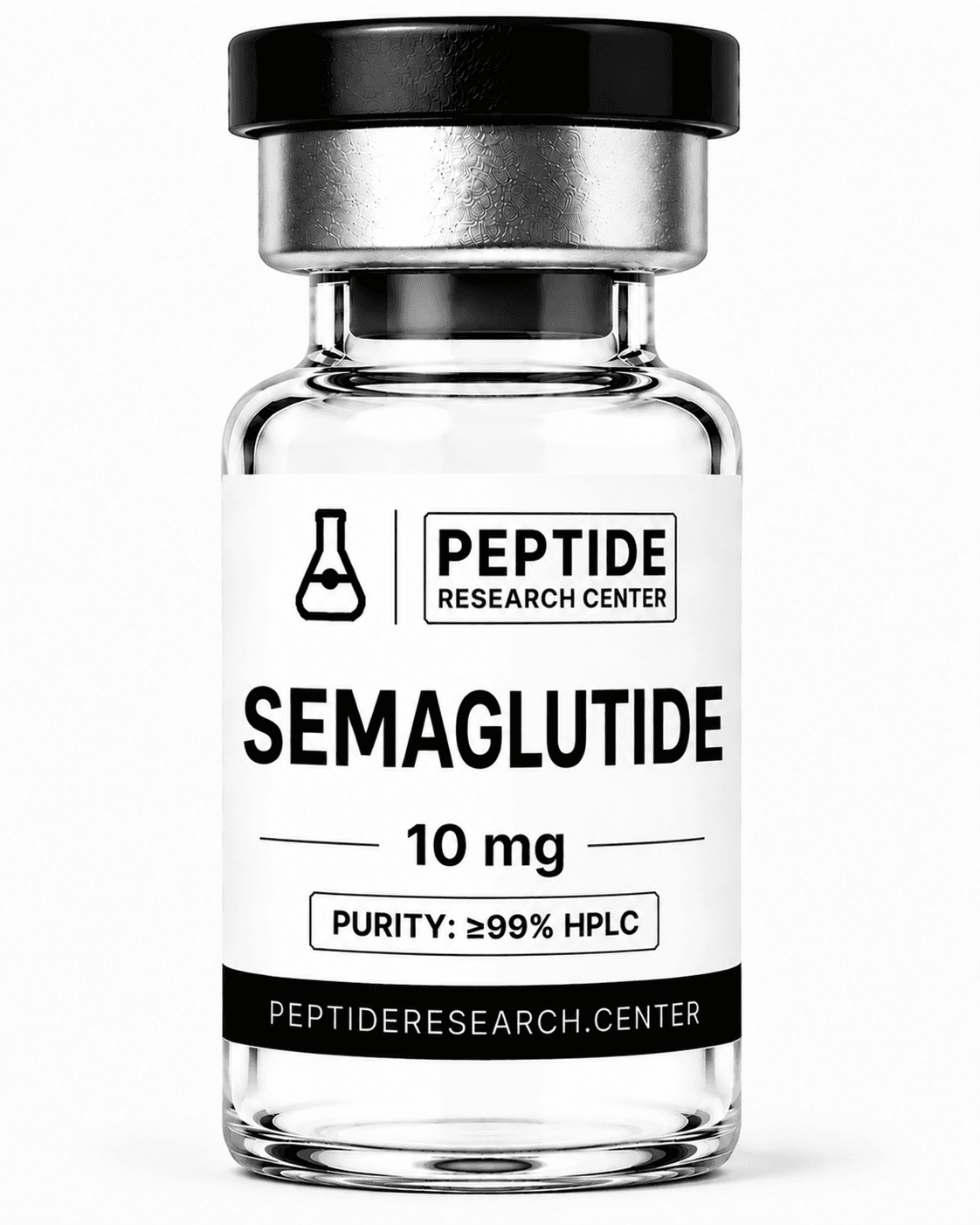
Semaglutide
GLP-1 receptor agonist • Metabolic research
Semaglutide is a long-acting GLP-1 receptor agonist peptide and one of the most extensively studied compounds in incretin and metabolic research.
One-time payment, no recurring charge. Ships together.
SKU: PRC-SEMA-10
Research Use Only. Not for human or veterinary use. By ordering you confirm you are a qualified researcher.
Purity Verification
HPLC Purity
>99% HPLC
Mass Spec Verified
ESI-MS
Certificate of Analysis
Per batch
Preparation & Handling
Supplied as lyophilized powder. Store unreconstituted vials at -20 °C, protected from light. Reconstitute with bacteriostatic or sterile water; once reconstituted, store at 2–8 °C and use within the validated stability window. Do not freeze-thaw repeatedly. For laboratory research use only.
The Science Behind Semaglutide
Semaglutide is a long-acting GLP-1 receptor agonist and one of the most extensively studied molecules in incretin and metabolic science. Its published literature covers its acylated molecular design, GLP-1 receptor pharmacology, an SNAC-based oral-delivery technology, and large clinical programmes in type 2 diabetes (SUSTAIN) and obesity (STEP). The summaries below describe that literature on the semaglutide molecule, with citations, for scientific reference only — the research-grade peptide supplied here is not the approved medicine and is intended solely for in-vitro and laboratory use.
Overview
Semaglutide is a long-acting analogue of glucagon-like peptide-1 (GLP-1) that acts as a GLP-1 receptor agonist. [1] It has been studied in both subcutaneous (once-weekly) and oral formulations and is a standard reference compound across incretin-pathway research. [1]
Molecular design & half-life
Semaglutide is derived from native GLP-1 with targeted modifications: an Aib substitution that confers resistance to DPP-4 degradation and a C18 fatty-diacid chain that drives strong albumin binding. [2] These changes extend the circulating half-life from minutes (native GLP-1) to roughly a week, the basis for once-weekly administration in studies. [2]
Mechanism: GLP-1 receptor
As a GLP-1 receptor agonist, semaglutide engages the GLP-1 receptor to enhance glucose-dependent insulin secretion, slow gastric emptying, and act on central appetite-regulating pathways. [1] Because insulin secretion through this receptor is glucose-dependent, the literature discusses a comparatively low intrinsic hypoglycaemia risk for the mechanism. [1]
Discovery & development
The medicinal-chemistry programme that produced semaglutide — building on the earlier analogue liraglutide — has been documented in detail, describing how the acylation and backbone modifications were engineered to balance receptor potency with a long half-life. [2]
Oral-delivery research
Because peptides are normally poorly absorbed when swallowed, researchers co-formulated an oral semaglutide with the absorption enhancer SNAC (sodium N-[8-(2-hydroxybenzoyl)amino]caprylate), which was shown to enable transcellular absorption across the stomach epithelium. [3] This is a notable example of oral peptide-delivery research.
Clinical research
Semaglutide has been evaluated in extensive clinical programmes: the SUSTAIN trials in type 2 diabetes, summarised within the GLP-1 receptor-agonist literature, [1] and the STEP programme in overweight and obesity — in STEP-1, once-weekly semaglutide was investigated in adults with overweight or obesity, with the trial reporting substantial weight reduction versus placebo. [4] These outcomes belong to controlled trials of the pharmaceutical product in enrolled patients.
Safety profile & research-use context
Reviews have catalogued semaglutide's studied safety profile, with gastrointestinal effects most commonly reported across trials. [5] Such findings describe the approved medicine in clinical use and do not transfer to the research-grade material supplied here, which is for in-vitro and laboratory study only — not formulated, dosed, or authorised for human or veterinary use. [1]
References
- 1.Nauck MA, Quast DR, Wefers J, et al. GLP-1 receptor agonists in the treatment of type 2 diabetes — state-of-the-art. Mol Metab. 2020;46:101102.
- 2.Knudsen LB, Lau J. The discovery and development of liraglutide and semaglutide. Front Endocrinol (Lausanne). 2019;10:155.
- 3.Buckley ST, Bækdal TA, Vegge A, et al. Transcellular stomach absorption of a derivatized glucagon-like peptide-1 receptor agonist. Sci Transl Med. 2018;10(467):eaar7047.
- 4.Wilding JPH, Batterham RL, Calanna S, et al. Once-weekly semaglutide in adults with overweight or obesity (STEP 1). N Engl J Med. 2021;384(11):989–1002.
- 5.Smits MM, Van Raalte DH. Safety of semaglutide. Front Endocrinol (Lausanne). 2021;12:645563.
Research Use Only. The information above is provided for educational and reference purposes only and summarizes third-party laboratory and preclinical research. Peptide Research Center products are intended solely for in-vitro and laboratory research by qualified professionals — not for human or veterinary use, diagnosis, or treatment. Nothing here constitutes medical advice or a therapeutic claim.