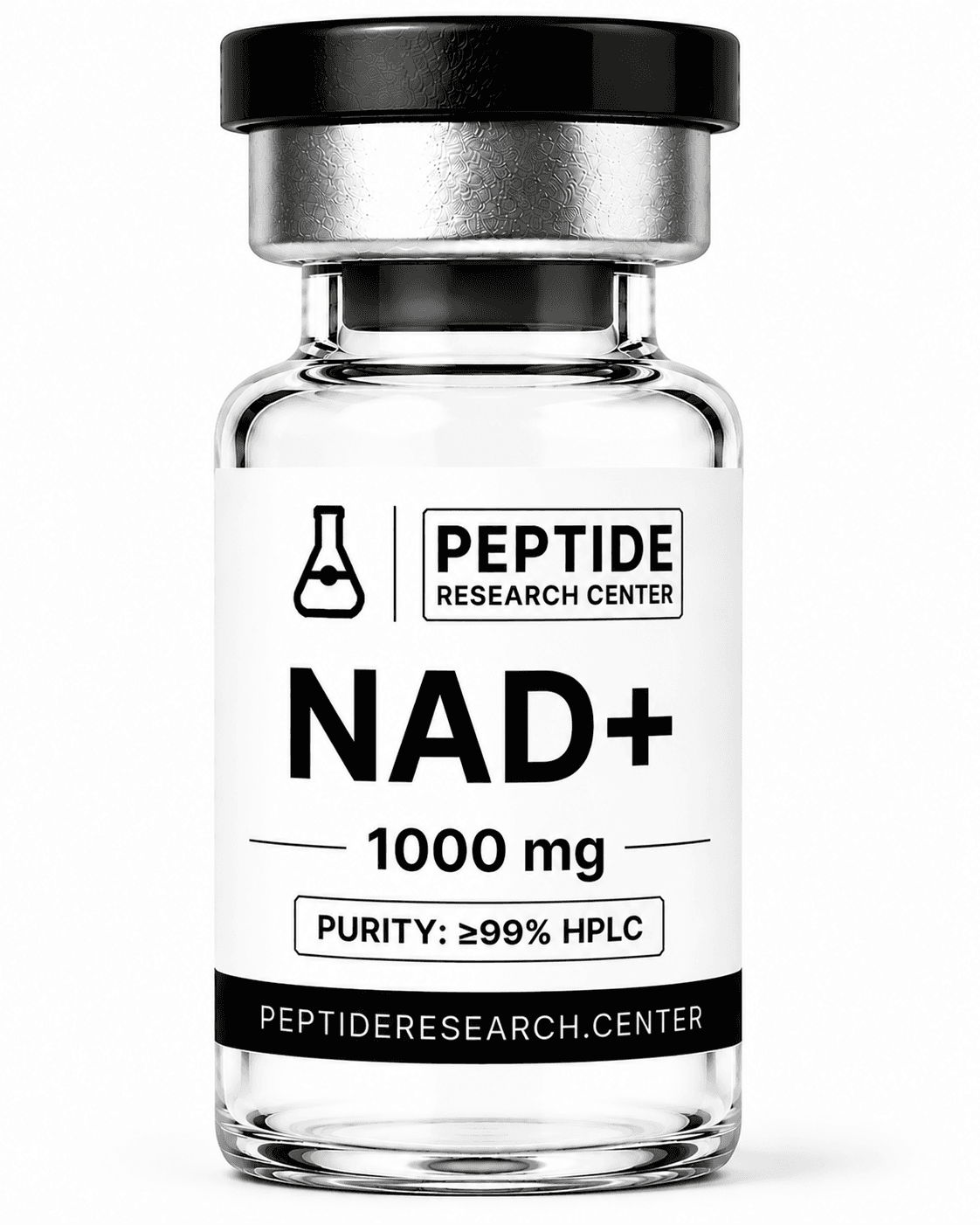
NAD+
Nicotinamide adenine dinucleotide • Cellular energy research
NAD+ (nicotinamide adenine dinucleotide) is a central coenzyme in cellular energy metabolism and a key reference compound in longevity and mitochondrial research.
One-time payment, no recurring charge. Ships together.
SKU: PRC-NAD-1000
Research Use Only. Not for human or veterinary use. By ordering you confirm you are a qualified researcher.
Purity Verification
HPLC Purity
>99% HPLC
Mass Spec Verified
ESI-MS
Certificate of Analysis
Per batch
Preparation & Handling
Supplied as lyophilized powder. Store unreconstituted vials at -20 °C, protected from light. Reconstitute with bacteriostatic or sterile water; once reconstituted, store at 2–8 °C and use within the validated stability window. Do not freeze-thaw repeatedly. For laboratory research use only.
The Science Behind NAD+
NAD+ (nicotinamide adenine dinucleotide) is one of the most fundamental molecules in cell biology — an electron carrier in energy metabolism and a consumable co-substrate for a family of signalling enzymes. Its decline with age and the strategies used to restore it are a central theme of modern geroscience. The summaries below describe that literature with citations, for research context only; this material is supplied for in-vitro and laboratory use, not for human or veterinary use.
Overview
NAD+ (nicotinamide adenine dinucleotide) is a coenzyme present in all living cells. It is central to energy metabolism both as an electron carrier in redox reactions — cycling between NAD+ and NADH across glycolysis, the TCA cycle, and oxidative phosphorylation — and as a co-substrate consumed by a set of signalling enzymes. [1]
Mechanism: redox vs. signalling pools
A key distinction in the literature is between NAD+'s catalytic redox role (where it is recycled, not consumed) and its role as a substrate that is degraded by non-redox enzymes. The latter links NAD+ availability directly to downstream signalling, because every signalling reaction lowers the cellular NAD+ pool. [2]
NAD+-consuming enzymes
Three enzyme families consume NAD+: the sirtuins (NAD+-dependent deacylases tied to gene regulation and mitochondrial function), the poly(ADP-ribose) polymerases (PARPs, central to DNA-damage repair), and the NADase CD38. [2] Their shared dependence on NAD+ means these pathways compete for a common, limited pool — a concept widely used to interpret metabolic and DNA-repair research. [1]
Decline with age & geroscience
Cellular NAD+ availability falls with age across many tissues, an observation that has made NAD+ metabolism a major focus of geroscience. Reviews describe associations between declining NAD+, increased CD38 activity, cellular senescence, and several biological hallmarks of aging. [3]
NAD+-boosting strategies
A large body of work examines whether raising NAD+ — through precursors such as nicotinamide mononucleotide (NMN) and nicotinamide riboside (NR), or through enzyme modulation — affects metabolic and age-related endpoints in model systems. The in-vivo evidence for these NAD-boosting molecules has been systematically reviewed. [4]
Research-use context
These materials are supplied strictly for in-vitro and laboratory research by qualified professionals. Nothing in the summaries above is a therapeutic claim, and the compound is not formulated, dosed, or authorised for use in humans or animals.
References
- 1.Verdin E. NAD+ in aging, metabolism, and neurodegeneration. Science. 2015;350(6265):1208–1213.
- 2.Covarrubias AJ, Perrone R, Grozio A, et al. NAD+ metabolism and its roles in cellular processes during ageing. Nat Rev Mol Cell Biol. 2021;22(2):119–141.
- 3.Chini CCS, Cordeiro HS, Tran NLK, et al. NAD metabolism: role in senescence regulation and aging. Aging Cell. 2024;23(1):e13920.
- 4.Rajman L, Chwalek K, Sinclair DA. Therapeutic potential of NAD-boosting molecules: the in vivo evidence. Cell Metab. 2018;27(3):529–547.
Research Use Only. The information above is provided for educational and reference purposes only and summarizes third-party laboratory and preclinical research. Peptide Research Center products are intended solely for in-vitro and laboratory research by qualified professionals — not for human or veterinary use, diagnosis, or treatment. Nothing here constitutes medical advice or a therapeutic claim.