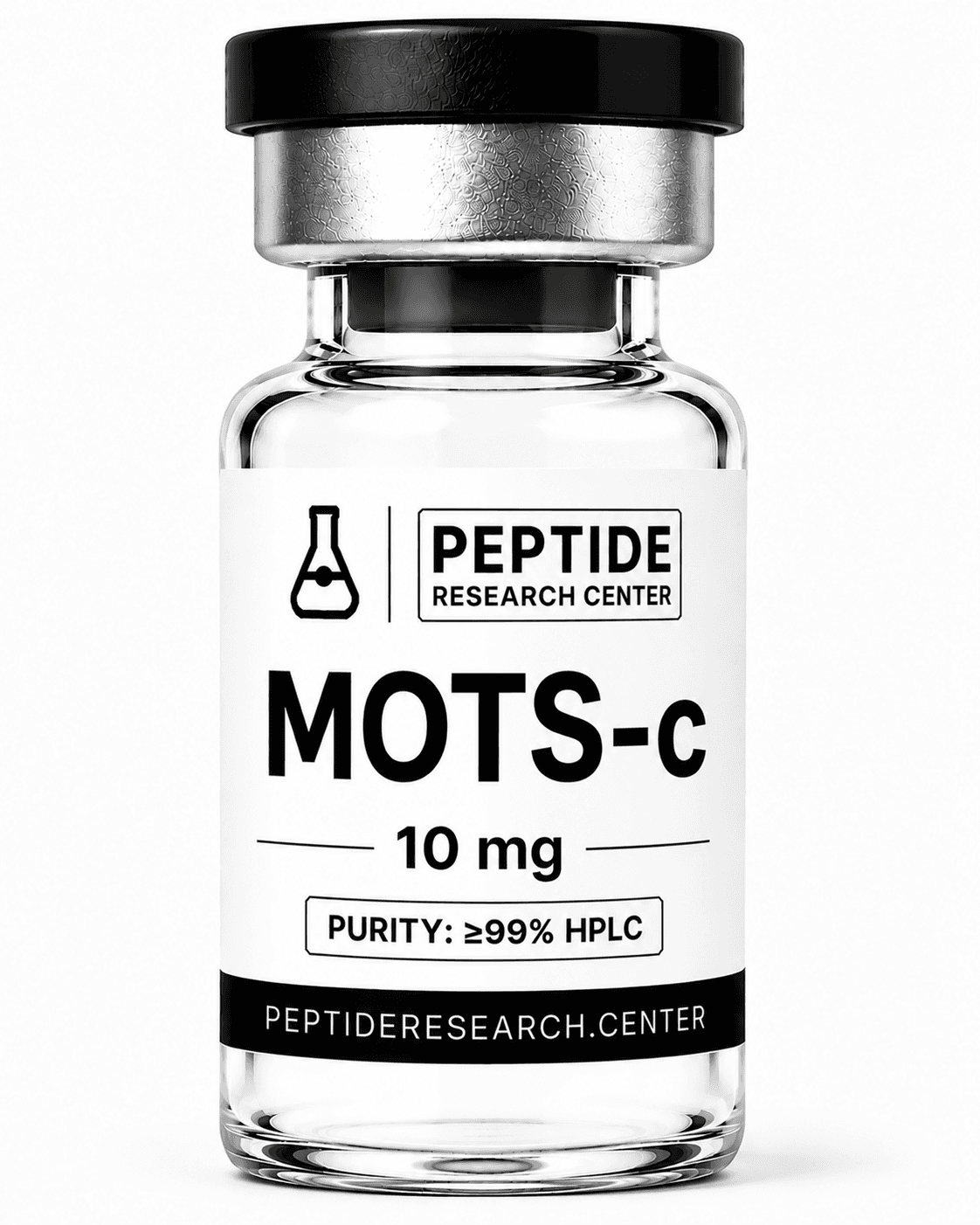
MOTS-c
Mitochondrial-derived peptide • Metabolic research
MOTS-c is a mitochondrial-derived peptide studied for its role in metabolic regulation and cellular stress-response research.
One-time payment, no recurring charge. Ships together.
SKU: PRC-MOTSC-10
Research Use Only. Not for human or veterinary use. By ordering you confirm you are a qualified researcher.
Purity Verification
HPLC Purity
>99% HPLC
Mass Spec Verified
ESI-MS
Certificate of Analysis
Per batch
Preparation & Handling
Supplied as lyophilized powder. Store unreconstituted vials at -20 °C, protected from light. Reconstitute with bacteriostatic or sterile water; once reconstituted, store at 2–8 °C and use within the validated stability window. Do not freeze-thaw repeatedly. For laboratory research use only.
The Science Behind MOTS-c
MOTS-c is a mitochondrial-derived peptide — a short peptide encoded within the mitochondrial genome itself — and a fast-growing focus of metabolic and aging research. The literature centres on its role in metabolic homeostasis through AMPK signalling, its exercise-induced translocation from mitochondria to the nucleus, and its broader effects in disease models. The summaries below describe that literature with citations, for research context only; this material is for in-vitro and laboratory use, not for human or veterinary use.
Overview
MOTS-c (Mitochondrial ORF of the 12S rRNA type-c) is a 16-amino-acid peptide encoded within the mitochondrial genome rather than the nucleus — one of a small class of “mitochondrial-derived peptides.” It is studied as a mitochondrial-to-nuclear signalling molecule that, under metabolic stress, can translocate to the nucleus and influence nuclear gene expression. [1][2]
Discovery & metabolic homeostasis
In the foundational study, MOTS-c was shown to target skeletal muscle and regulate metabolic homeostasis: it activated AMP-activated protein kinase (AMPK) and acted through the folate–methionine cycle, and in animal models it reduced diet-induced obesity and insulin resistance. [1] This positioned MOTS-c as an endogenous regulator of insulin sensitivity and glucose handling.
Exercise & mitochondrial–nuclear signalling
Later work characterised MOTS-c as an exercise-responsive regulator. Physical stress was reported to drive its nuclear translocation, where it engages stress-adaptation gene programmes; the peptide has therefore been described as an “exercise-induced” mitochondrial signal linking activity to metabolic adaptation. [4]
Aging & broader research
Reviews summarise ongoing exploration of MOTS-c across aging, exercise physiology, and metabolic regulation, including its relationship to age-associated decline in mitochondrial function. [2] Recent preclinical work continues to examine mitochondrial-derived-peptide signalling in additional cellular and disease models. [3]
Research-use context
MOTS-c is an active area of basic research, and the evidence above comes from cell and animal models. This material is supplied strictly for in-vitro and laboratory study by qualified professionals — it is not formulated, dosed, or authorised for use in humans or animals, and nothing here is a therapeutic claim.
References
- 1.Lee C, Zeng J, Drew BG, et al. The mitochondrial-derived peptide MOTS-c promotes metabolic homeostasis and reduces obesity and insulin resistance. Cell Metab. 2015;21(3):443–454.
- 2.Zheng Y, Wei Z, Wang T. MOTS-c: a promising mitochondrial-derived peptide for therapeutic exploitation. Front Endocrinol (Lausanne). 2023;14:1120533.
- 3.Yin Y, Li Y, Ma B, et al. Mitochondrial-derived peptide MOTS-c suppresses ovarian cancer progression by attenuating USP7-mediated LARS1 deubiquitination. Adv Sci (Weinh). 2024;11(43):e2405620.
- 4.Reynolds JC, Lai RW, Woodhead JST, et al. MOTS-c is an exercise-induced mitochondrial-encoded regulator of age-dependent physical decline and muscle homeostasis. Nat Commun. 2021;12(1):470.
Research Use Only. The information above is provided for educational and reference purposes only and summarizes third-party laboratory and preclinical research. Peptide Research Center products are intended solely for in-vitro and laboratory research by qualified professionals — not for human or veterinary use, diagnosis, or treatment. Nothing here constitutes medical advice or a therapeutic claim.