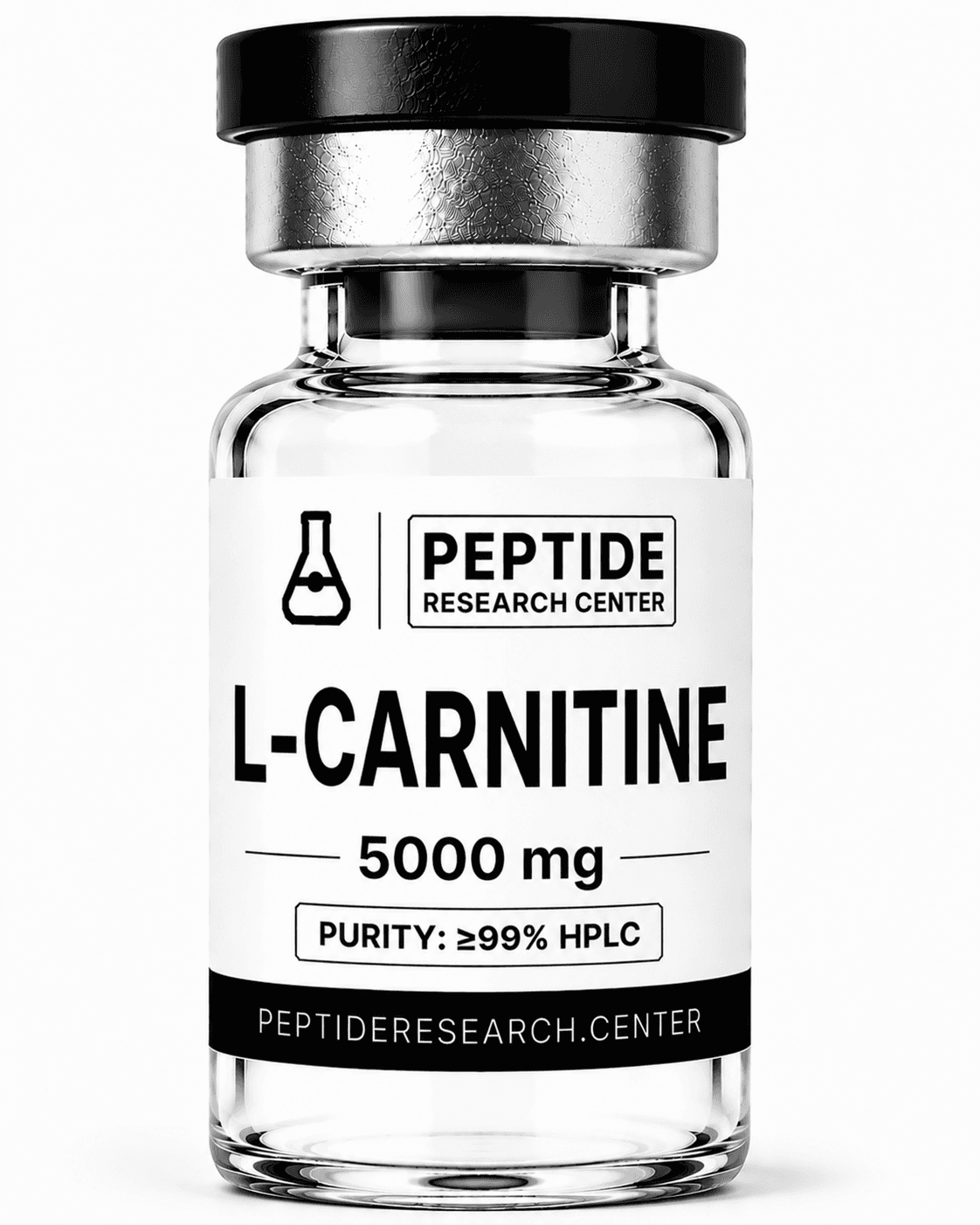
L-Carnitine
Amino-acid derivative • Fatty-acid metabolism research
L-Carnitine is an amino-acid derivative central to fatty-acid transport into mitochondria, studied widely in energy-metabolism research.
One-time payment, no recurring charge. Ships together.
SKU: PRC-LCARN-5000
Research Use Only. Not for human or veterinary use. By ordering you confirm you are a qualified researcher.
Purity Verification
HPLC Purity
>99% HPLC
Mass Spec Verified
ESI-MS
Certificate of Analysis
Per batch
Preparation & Handling
Supplied as a 10 mL solution (500 mg/mL). Store at 2–8 °C, protected from light. For laboratory research use only.
The Science Behind L-Carnitine
L-Carnitine is a small amino-acid derivative with an outsized role in energy metabolism: it carries long-chain fatty acids into mitochondria for β-oxidation and buffers the cell's acyl-CoA pool. The research literature spans its transport mechanism, the diagnostic significance of acylcarnitines, and its study in muscle bioenergetics, exercise recovery, and aging models. The summaries below describe that literature with citations, for research context only; this material is for in-vitro and laboratory use, not for human or veterinary use.
Overview
L-Carnitine is an amino-acid derivative central to mitochondrial energy metabolism, best known for transporting long-chain fatty acids into the mitochondrial matrix where β-oxidation occurs. [1] It is synthesised endogenously from lysine and methionine and also obtained from the diet.
Mechanism: the carnitine shuttle
Through the carnitine palmitoyltransferase system (CPT1 on the outer mitochondrial membrane and CPT2 on the inner), L-carnitine forms acylcarnitines that shuttle activated fatty acids across the mitochondrial membranes. [2] CPT1 is the rate-limiting, regulated step of fatty-acid oxidation, which makes carnitine availability a key node in how cells choose between fat and carbohydrate fuel. [1]
Acylcarnitines & metabolic flexibility
The carnitine system also buffers cells against accumulation of acyl-CoA. Targeted-metabolomics research found that, in obesity-related skeletal-muscle insulin resistance, incomplete β-oxidation leads to a build-up of acylcarnitine intermediates and impaired fuel switching — work that made acylcarnitine profiling a window into mitochondrial “overload.” [3]
Muscle bioenergetics & exercise research
Carnitine has been studied extensively in human muscle bioenergetics, exploring whether carnitine status influences substrate utilisation and physical performance. [1] Reviews of exercise-recovery research describe reported effects on markers of muscle damage, oxidative stress, and post-exercise recovery in study populations. [4]
Aging research
Carnitine metabolism is also examined in the context of aging, where animal and human studies have looked at its relationship to muscle mass, mitochondrial homeostasis, and fatigue. [4] These remain active research questions rather than settled conclusions.
Research-use context
This material is supplied strictly for in-vitro and laboratory research by qualified professionals. Nothing in the summaries above is a therapeutic or nutritional claim, and the compound is not formulated, dosed, or authorised for use in humans or animals.
References
- 1.Gnoni A, Longo S, Gnoni GV, et al. Carnitine in human muscle bioenergetics: can carnitine supplementation improve physical exercise? Molecules. 2020;25(1):182.
- 2.Choi J, Smith DM, Scafidi S, et al. Carnitine palmitoyltransferase 1 facilitates fatty acid oxidation in a non-cell-autonomous manner. Cell Rep. 2024;43(12):115006.
- 3.Koves TR, Ussher JR, Noland RC, et al. Mitochondrial overload and incomplete fatty acid oxidation contribute to skeletal muscle insulin resistance. Cell Metab. 2008;7(1):45–56.
- 4.Fielding R, Riede L, Lugo JP, Bellamine A. l-Carnitine supplementation in recovery after exercise. Nutrients. 2018;10(3):349.
Research Use Only. The information above is provided for educational and reference purposes only and summarizes third-party laboratory and preclinical research. Peptide Research Center products are intended solely for in-vitro and laboratory research by qualified professionals — not for human or veterinary use, diagnosis, or treatment. Nothing here constitutes medical advice or a therapeutic claim.