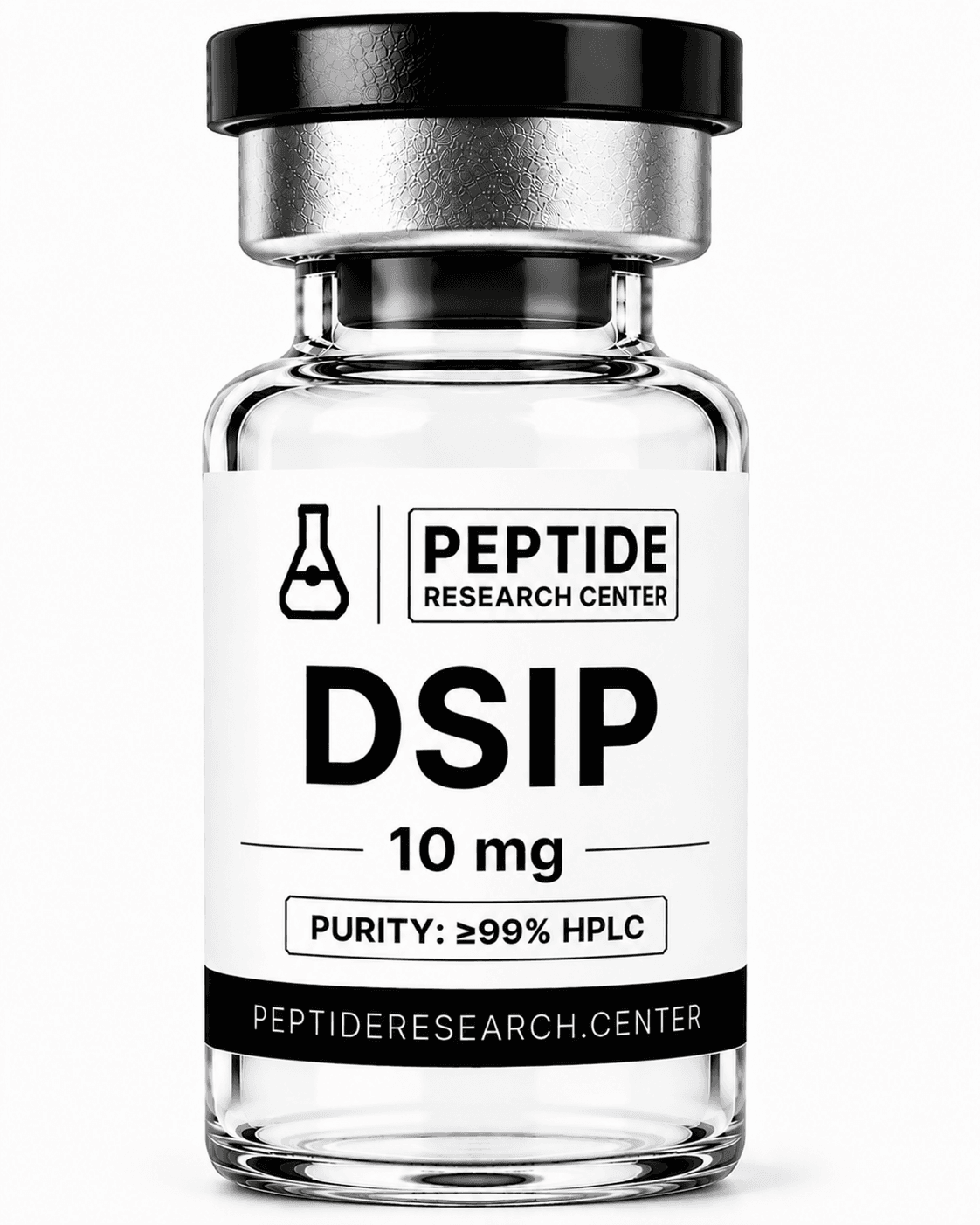
DSIP
Delta sleep-inducing peptide • Sleep & neuro research
DSIP (Delta Sleep-Inducing Peptide) is a neuromodulatory nonapeptide studied in sleep-architecture and stress-response research models.
SKU: PRC-DSIP-10
Research Use Only. Not for human or veterinary use. By ordering you confirm you are a qualified researcher.
Purity Verification
HPLC Purity
>99% HPLC
Mass Spec Verified
ESI-MS
Certificate of Analysis
Per batch
Preparation & Handling
Supplied as lyophilized powder. Store unreconstituted vials at -20 °C, protected from light. Reconstitute with bacteriostatic or sterile water; once reconstituted, store at 2–8 °C and use within the validated stability window. Do not freeze-thaw repeatedly. For laboratory research use only.
The Science Behind DSIP
Delta sleep-inducing peptide (DSIP) is one of the more enigmatic neuropeptides: isolated in 1977 and named for its proposed sleep-promoting activity, it has resisted firm mechanistic explanation for decades. The literature spans its unusual structure, a broad range of reported “extra-sleep” effects, its presence in cerebrospinal fluid and relationship to age, and the open question of whether it is a true sleep factor. The summaries below describe that literature with citations, for research context only; this material is for in-vitro and laboratory use, not for human or veterinary use.
Overview
Delta sleep-inducing peptide (DSIP) is a nonapeptide first isolated in 1977 from the cerebral venous blood of rabbits during electrically induced sleep. It was originally proposed as a sleep-promoting (delta-wave-enhancing) factor, though its precise physiological role and mechanism remain incompletely characterised. [1]
Structure & identity
DSIP is a small, acidic nonapeptide of molecular weight ~849 whose sequence does not resemble any other known peptide family. [1] A naturally occurring phosphorylated form (P-DSIP, phosphorylated at Ser7) has also been described, and the existence of DSIP-like immunoreactivity has complicated efforts to pin down a single endogenous molecule and receptor. [3]
Reported sleep & “extra-sleep” effects
Classic reviews catalogued a wide spectrum of activity reported across animal models: in addition to delta-sleep induction (and, in cats, effects on REM sleep), researchers reported actions on electrophysiological activity, neurotransmitter levels, circadian and locomotor patterns, hormonal levels, thermoregulation, and stress responses — often following a characteristic U-shaped dose-response. [1][2]
Neuroendocrine & aging research
DSIP-like immunoreactivity has been measured in cerebrospinal fluid and peripheral tissues. One study reported that DSIP-like immunoreactivity in CSF correlated positively with age and differed in several neurodegenerative conditions, illustrating how DSIP has been studied as a marker in neuroendocrine and aging research rather than solely as a sleep peptide. [4]
Open questions
Despite decades of study, a firm link between DSIP and sleep has never been fully established, and the peptide is frequently described in the literature as a “still unresolved riddle” — in part because its gene, protein, and a definitive receptor have not been isolated. [3] This makes it a compound of continued basic-research interest rather than a defined pharmacological agent. [5]
Research-use context
Given the unsettled state of the science, DSIP is best understood as a research tool. This material is supplied strictly for in-vitro and laboratory study by qualified professionals — it is not formulated, dosed, or authorised for use in humans or animals, and nothing here is a therapeutic claim.
References
- 1.Graf MV, Kastin AJ. Delta-sleep-inducing peptide (DSIP): a review. Neurosci Biobehav Rev. 1984;8(1):83–93.
- 2.Graf MV, Kastin AJ. Delta-sleep-inducing peptide (DSIP): an update. Peptides. 1986;7(6):1165–1187.
- 3.Kovalzon VM, Strekalova TV. Delta sleep-inducing peptide (DSIP): a still unresolved riddle. J Neurochem. 2006;97(2):303–309.
- 4.Ernst A, Cramer H, Strubel D, Kuntzmann F, Schoenenberger GA. Comparison of DSIP- and P-DSIP-like immunoreactivity in cerebrospinal fluid of patients with senile dementia, multi-infarct syndrome, communicating hydrocephalus and Parkinson's disease. J Neurol. 1987;235(1):16–21.
- 5.Pollard BJ, Pomfrett CJ. Delta sleep-inducing peptide. Eur J Anaesthesiol. 2001;18(7):419–422.
Research Use Only. The information above is provided for educational and reference purposes only and summarizes third-party laboratory and preclinical research. Peptide Research Center products are intended solely for in-vitro and laboratory research by qualified professionals — not for human or veterinary use, diagnosis, or treatment. Nothing here constitutes medical advice or a therapeutic claim.